

At JSW Steel, we recognize that thriving ecosystems are fundamental to climate resilience, community well-being, and long-term business sustainability. Our operations intersect with diverse landscapes, and we are committed to ensuring that the natural environment around our sites is protected, restored, and enhanced.
Our approach aligns with global standards such as the UN Convention on Biological Diversity, the UN SDGs, and leading industry guidelines on nature-positive action.
We have built a state-of-the-art Nature Interpretation Centre (NIC) at the Daroji Bear Sanctuary, situated close to our Vijayanagar plant in Karnataka. Daroji is Asia’s largest and India's only natural habitat for Sloth Bears, created exclusively for its preservation. Today, it is home to 120 bears, along with leopards, hyenas, and several other animals. Nearly 90 species of birds and 27 species of butterflies have also been identified here.
The Natura Interpretation Centre, launched in association with the Forest Department of the Govt. of Karnataka, shines the spotlight on the stunning biodiversity in the region. With special focus on the Sloth Bear, it also supports its preservation in the country immensely.
Our ambition is to achieve no net loss of biodiversity across all major sites and work towards net-positive outcomes wherever feasible.
We work to safeguard biodiversity through a structured strategy that focuses on:
Avoiding and minimizing ecological impacts during project planning and operations
Restoring and enhancing local habitats through targeted conservation interventions
Strengthening ecosystem resilience around plant locations
Protecting native species and minimizing disturbance to flora and fauna
Engaging communities and experts in long-term conservation efforts
We are also committed to ensuring no net deforestation due to our own operations, and our commitment is endorsed by our executive management.
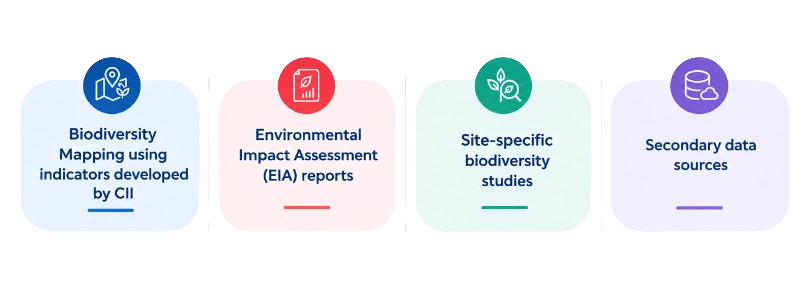
Our biodiversity risk assessment encompasses our own operations and adjacent areas, as well as upstream and downstream activities across the value chain, to identify and manage biodiversity-related impacts, dependencies and risks.
| Phase | Key Activities & Process Flow |
|---|---|
| Initial Review & Screening |
|
| Group-Level Standards |
|
| Detailed Site Assessment |
|
| Management & Measurement |
|
| Governance |
Monitoring, review, and reporting to stakeholders. |

Each JSW Steel facility prepares a Biodiversity Management Plan (BMP) based on scientific assessments of local ecosystems. These plans help us:
We partner with ecologists, forest departments, NGOs, and academic institutions to ensure scientific rigour in all assessments and programs.
The assessment was based on datasets and documentation provided by each site. These inputs were critically reviewed to develop an Impacts and Dependencies Matrix, which formed the foundation of our risk evaluation.
To address these risks and advance toward our No Net Loss (NLL) target, we are implementing a structured biodiversity risk mitigation hierarchy.
Changes in sentiment towards organization and its brand value due to impact on RET Species.
Any impact on protected biodiversity would trigger Wildlife Protection Act.
Shifting customer/investor preferences to products that have positive impacts on nature or mitigate negative impacts on nature.
Changes in protection from natural hazards such as cyclones due to change in hazard mitigation services and light pollution, pollination and carbon sequestration.
Changes in regulating and maintenance ecosystem services such as noise.
Changes in the state of surface water ecosystem.
To mitigate these risks and progress towards achieving our target of No Net Loss (NLL), we are adopting the following biodiversity risk mitigation hierarchy:
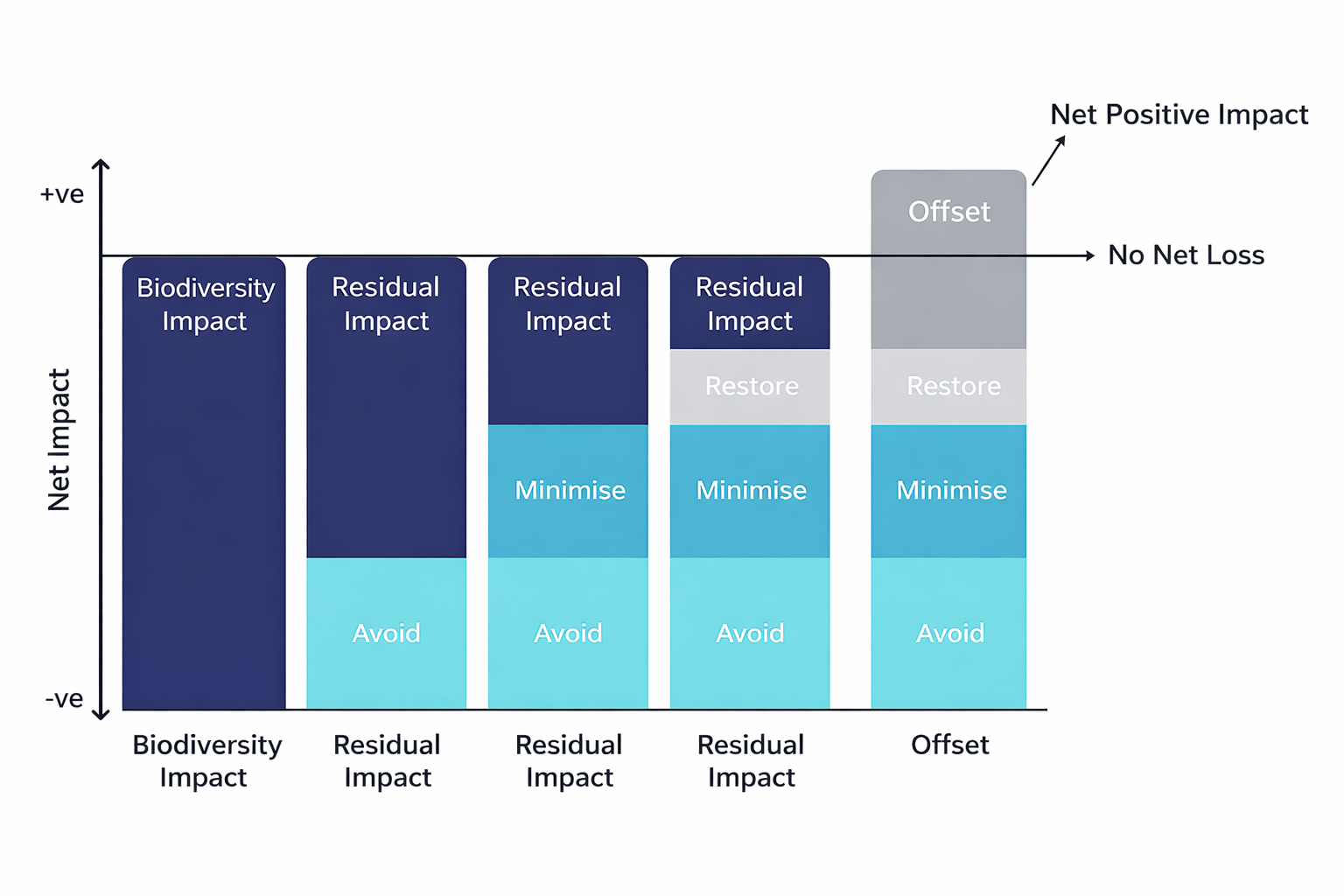
While applying the biodiversity risk mitigation hierarchy, we consider a range of influencing factors ecological, regulatory, economic, and reputational to guide our actions and interventions.
We have identified a set of activities and interventions aligned with each stage of the mitigation hierarchy, which can be implemented across the various phases of a manufacturing or mining site's lifecycle to effectively manage biodiversity risks.
Read more in our Integrated Annual Report
| Planning Phase | Construction Phase | Operation Phase |
|---|---|---|
| Avoidance of operations near protected areas, CRZ and Eco-sensitive zone of protected areas as per India's protected areas, IUCN protected areas categories I-IV, UNESCO World Heritage Sites and wetlands on the Ramsar Wetlands. | Avoidance through scheduling involves changing the timing of construction activities to avoid disturbing species during sensitive periods of their lifecycle. | Manual and machine removal of grasses and weed from the greenbelt areas. Removal after flowering and seeding season (Monsoon and start of winter). Avoidance of removal during nesting season (June to September). |
| Avoid acquiring Forest land and areas having high tree covers. | Minimizing tree cutting during construction phase along with protecting native tress species in the acquired areas as per baseline assessment. | Taking measures to reduce mortality to birds and bats by Windmill rotor blades. |
| Minimization of land use change for the project through planning infrastructure. | Avoidance or minimization of ground water extraction and surface water use during construction phase. | Avoid sourcing of water from high conservation wetlands and rivers having high biodiversity areas. |
| Integrating natural drainage system in the project design and avoidance of these areas during project planning phase. | Awareness creation of employees and workers for avoidance of snakes and birds nesting during management. | |
| Avoidance of migratory path areas of birds, wildlife and natural wetlands for land acquisition. | Avoidance or Minimization of extraction of ground water. |
When avoidance or minimization is not feasible, JSW Steel will restore and rehabilitate ecosystems using targeted, practical measures across project phases. Following are the actions that shall be implemented for restoration/rehabilitation of biodiversity or ecosystem services:
| Construction Phase | Operation Phase |
|---|---|
| Developing water harvesting structures to balance water requirement in construction phase | Developing landscape level interventions within project boundary to conserve water and regular maintenance of drainage system |
| Plantation of native tree in high noise and dust areas as a barrier | Restoration of natural ecosystems within project boundaries |
| Separately retaining and storing topsoil and sub-soil stripped from the construction areas for later use during reinstatement |
Plantation of native trees species Using indigenous and non-invasive species for landscaping and rehabilitation works. Using soil, mulch and vegetation debris (that contain natural seed stock) to facilitate natural revegetation of disturbed areas, where reasonably practicable. |
| Developing Fireline to reduce fire incident during the dry sessions | |
| Restoration of wetlands based on Ramsar Wetland convention - Principles and guidelines for wetland restoration to manage the Water requirements |
| Operation Phase |
|---|
| Regeneration of mangrove ecosystem by planting more than 23 lakh mangrove saplings bringing 450 hectares of degraded mangrove area under green cover. |
| Operation Phase |
|---|
|
• Undertake afforestation activity in the nearby areas of project to restore natural forest, control of invasive species and addressing drives of biodiversity loss. • Support local Forest office for protecting Rare, Endangered, Endemic and Threated Wildlife considering the criticality of the project and impacts on the specific species. • Restoration of wetlands based on Ramsar Wetland convention - Principles and guidelines for wetland restoration in proximity of the projects and sourcing location of water. • Invest in implementation of Ecosystem-based solution over technological solution for addressing biodiversity impacts (Ex. sewage water treatment for villages to reduce pollution load in natural wetlands and rivers). |

Stories
Social Media


© 2026 JSW Steel. All rights reserved
Privacy Policy

