

JSW Steel is committed to developing and scaling products that support the transition to a low-carbon economy while delivering transparency and value to customers.
Our Sustainable Products Programme integrates product innovation, environmental performance assessment, third-party verification and responsible manufacturing practices to enable customers to make informed procurement decisions and advance their decarbonisation objectives. As customer and regulatory expectations for product sustainability continue to evolve, we are strengthening our ability to measure, validate and communicate the environmental performance of our products through globally recognised sustainability frameworks and certifications.
We use the World Steel Association's Chain of Custody Guidelines, the Confederation of Indian Industry's GreenPro certification and third-party verified Environmental Product Declarations to identify and recognise sustainable products. Products are classified using quantified environmental performance criteria, including lifecycle greenhouse gas emissions, resource efficiency, recycled material content and broader environmental impacts assessed across the product lifecycle.
These frameworks combine lifecycle-based assessment with independent verification to provide transparent and credible information on product environmental performance. This enables customers to compare product attributes, integrate sustainability considerations into procurement decisions and substantiate their environmental and decarbonisation objectives.
Our sustainable product portfolio includes, but is not limited to:
JSW Steel is committed to expanding its portfolio of sustainable steel solutions through investments in low-carbon manufacturing technologies, renewable energy integration, product lifecycle assessment capabilities, sustainability certifications, and product traceability systems. The sustainable products current contribute to 80%. Our aim is to increase this portfolio of our products to contribute to >85% by 2030. We also support sustainable product innovation through ongoing research and development, infrastructure improvements that enable lower-carbon steel production, and capability-building programmes covering lifecycle assessment, sustainability certifications, and low-carbon product development and have invested 1,142 Crs on low carbon product development during FY 2025-26. These initiatives strengthen product transparency, support customer decarbonisation goals, and advance the transition to a low-carbon economy.
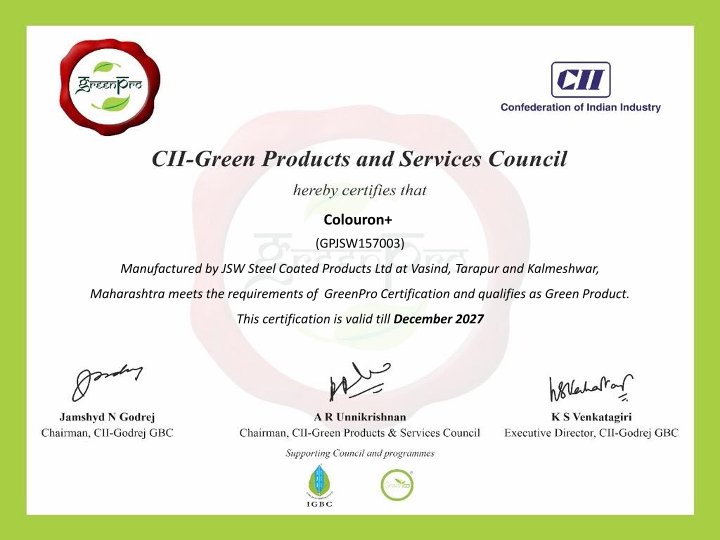
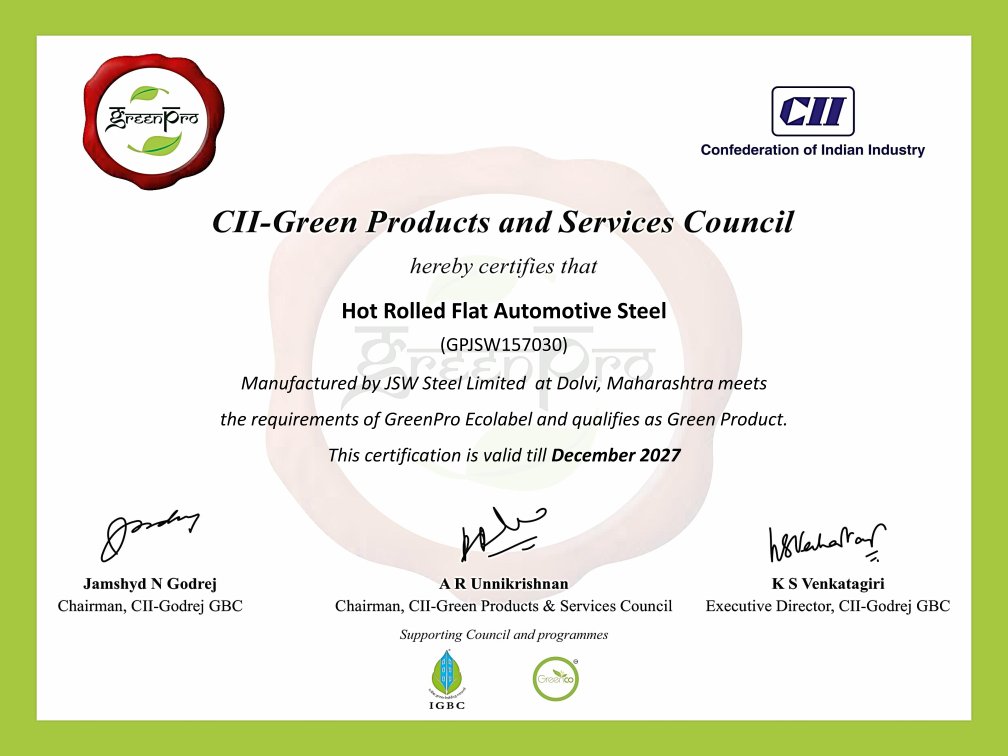
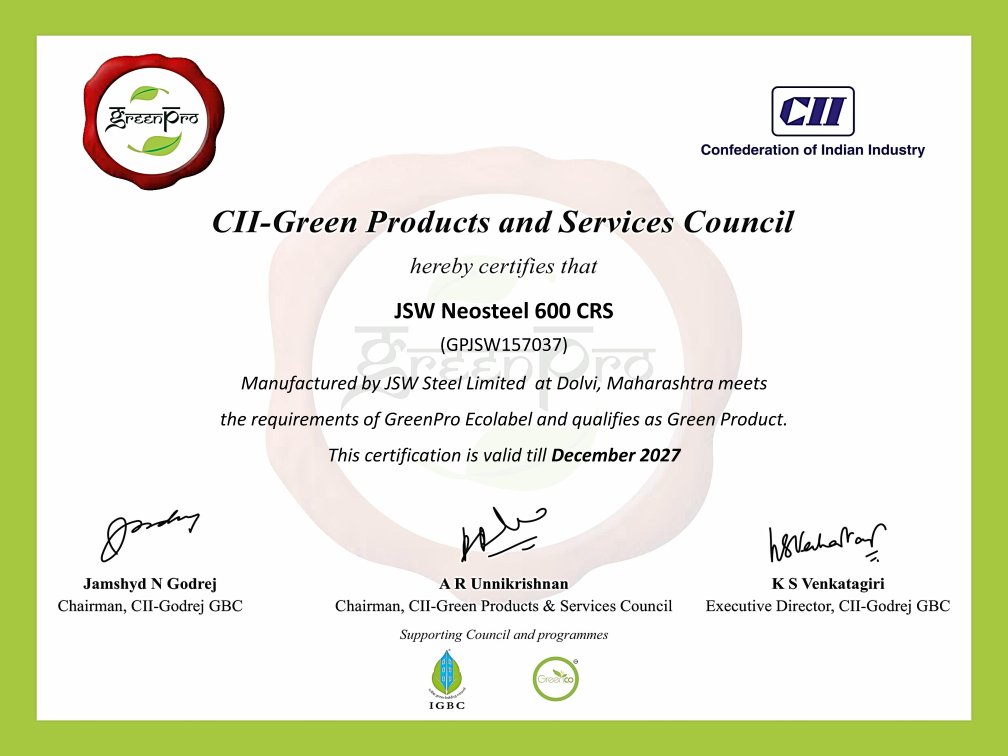
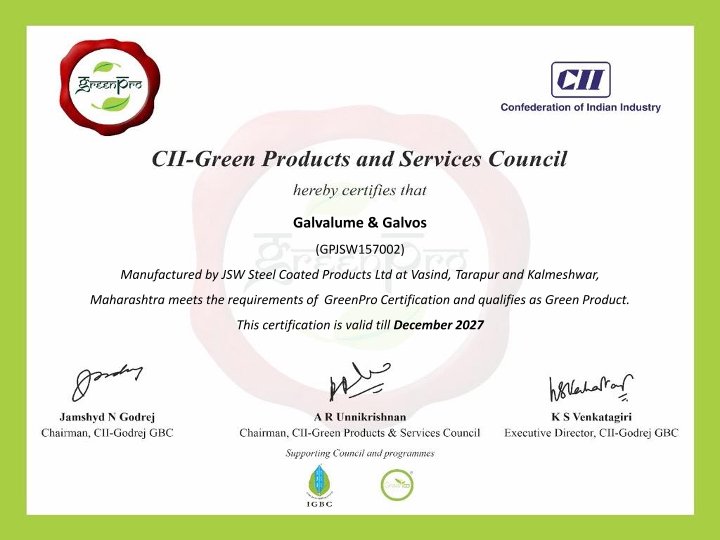
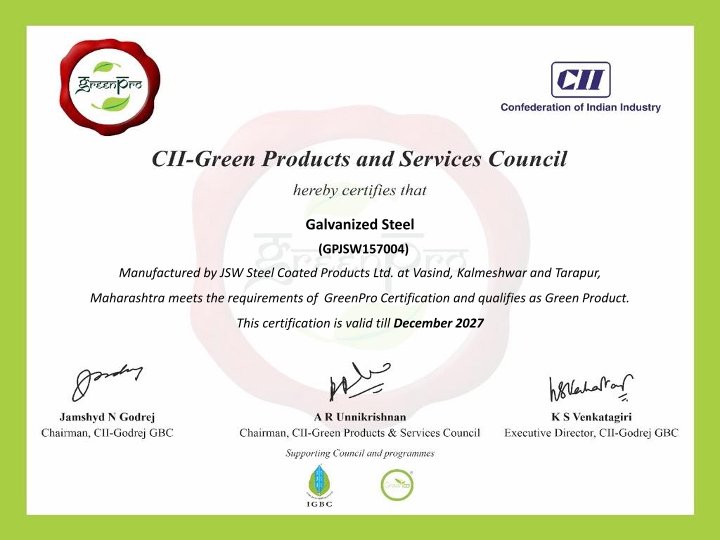
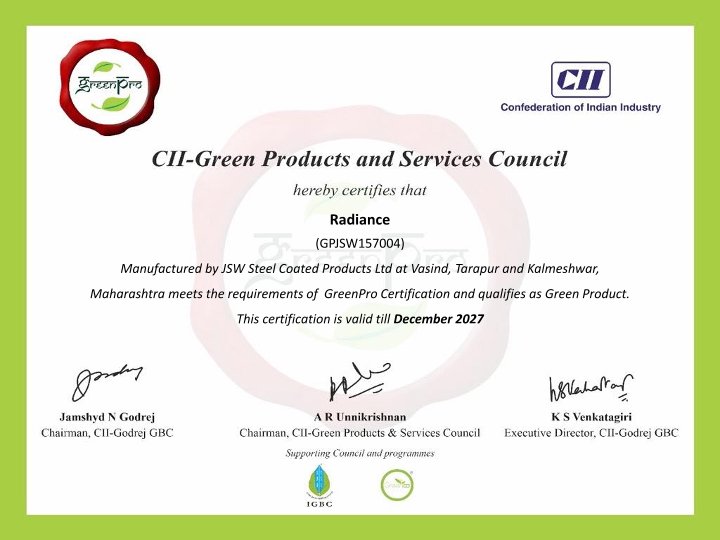
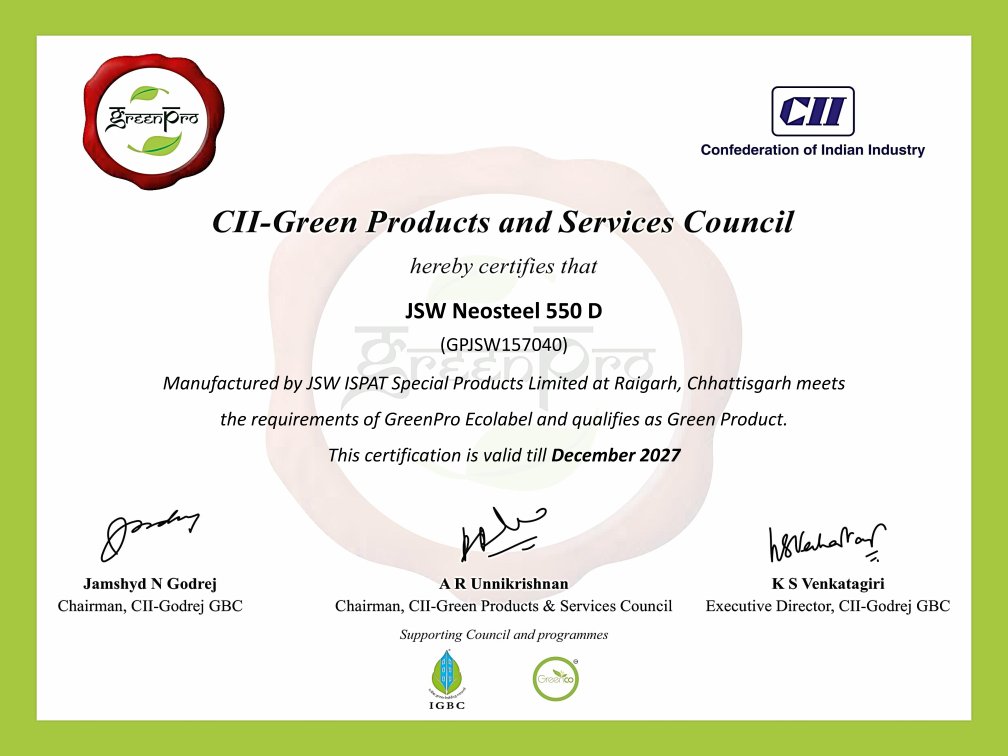
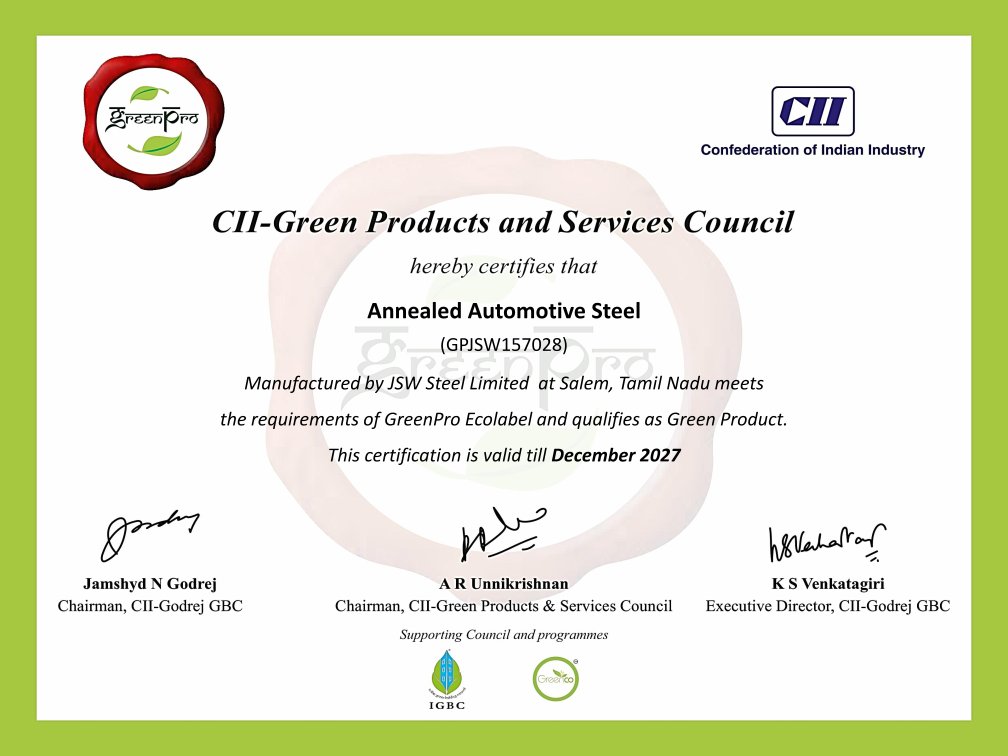
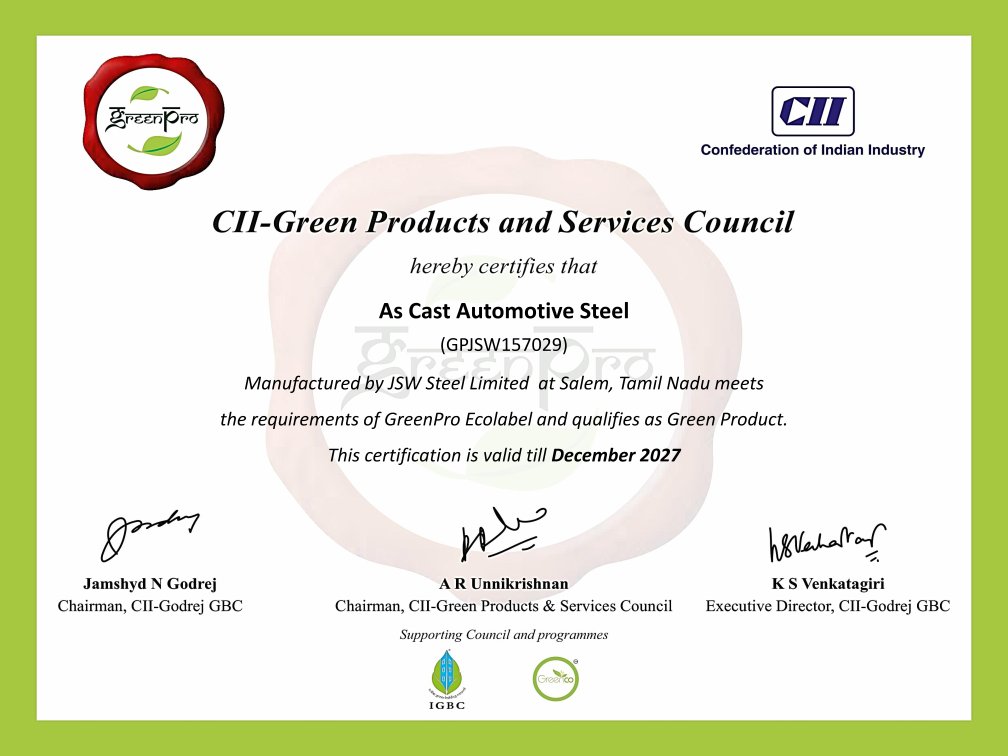
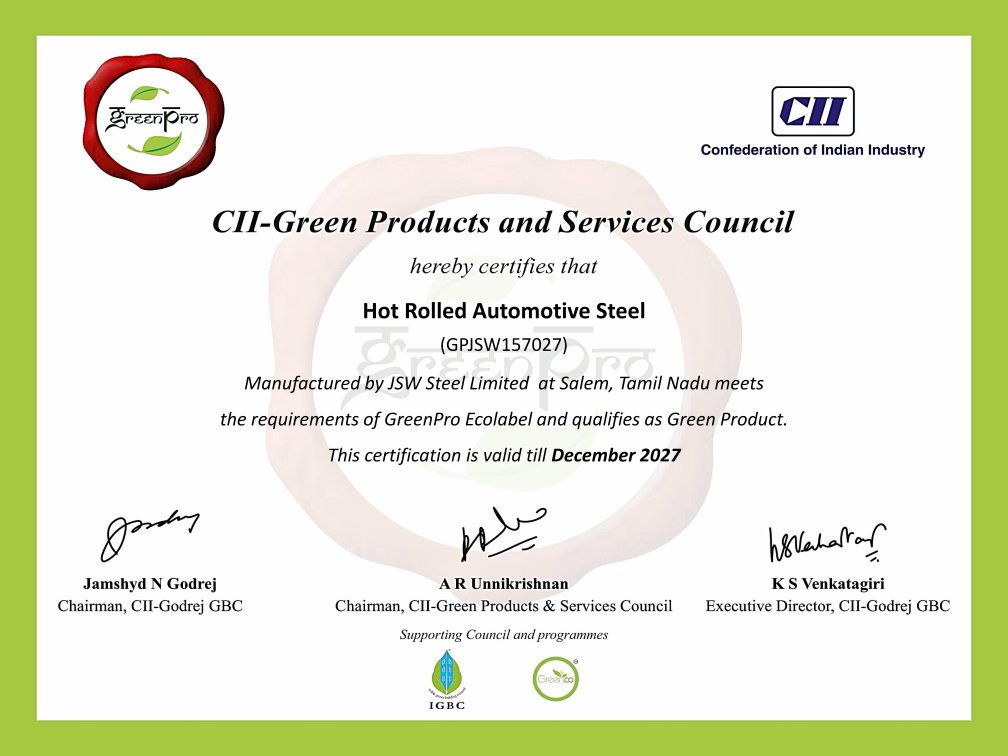
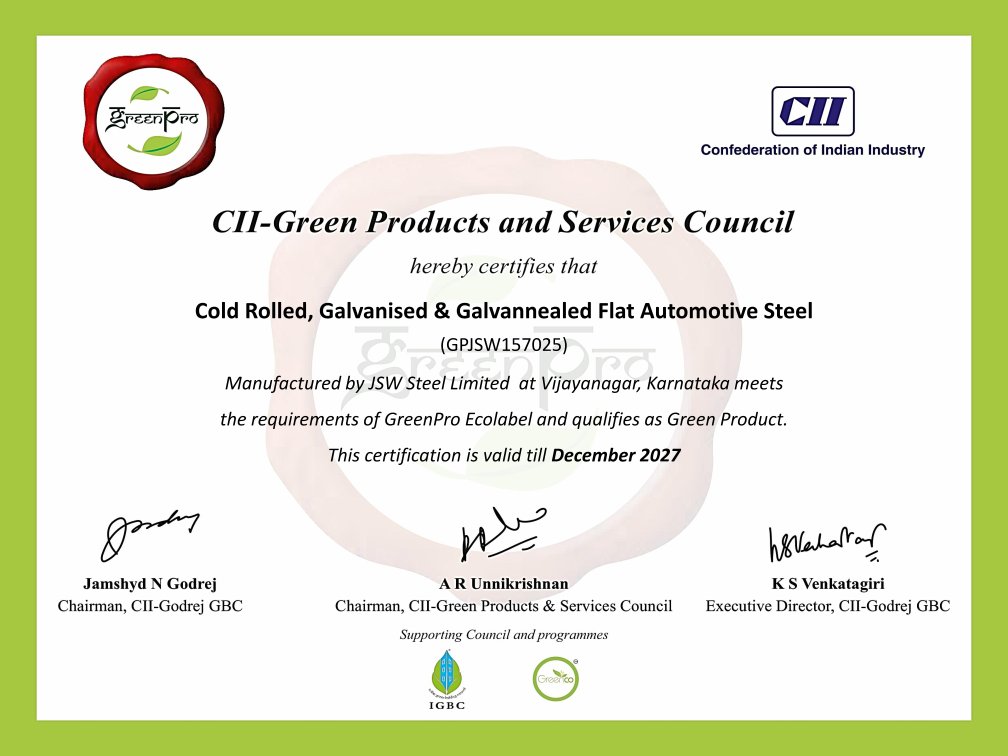
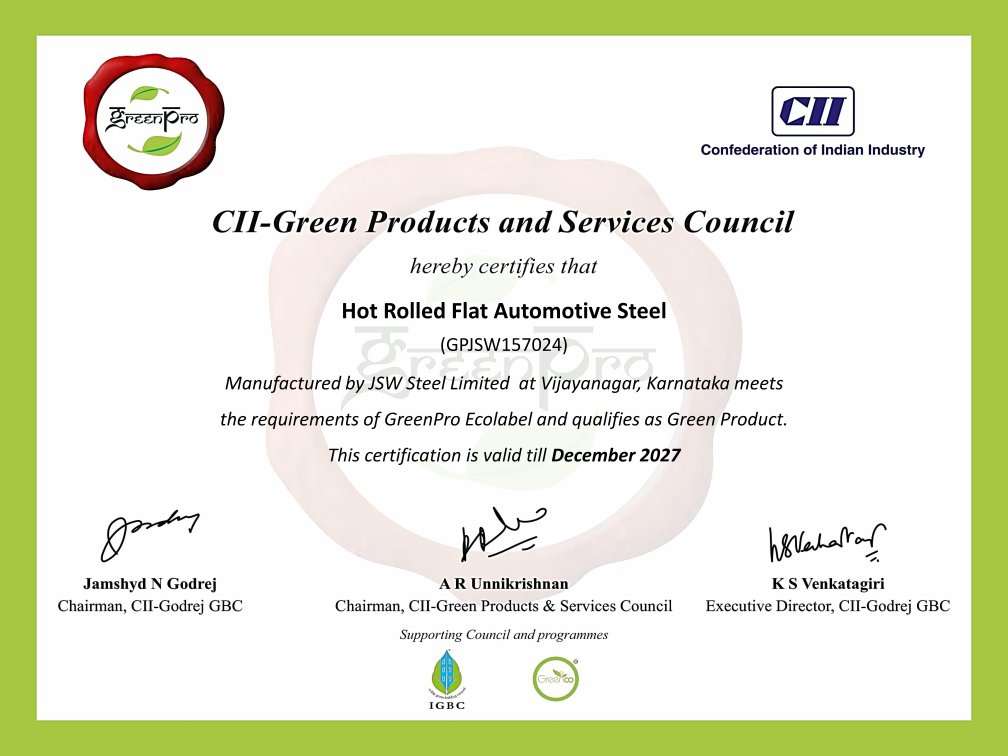
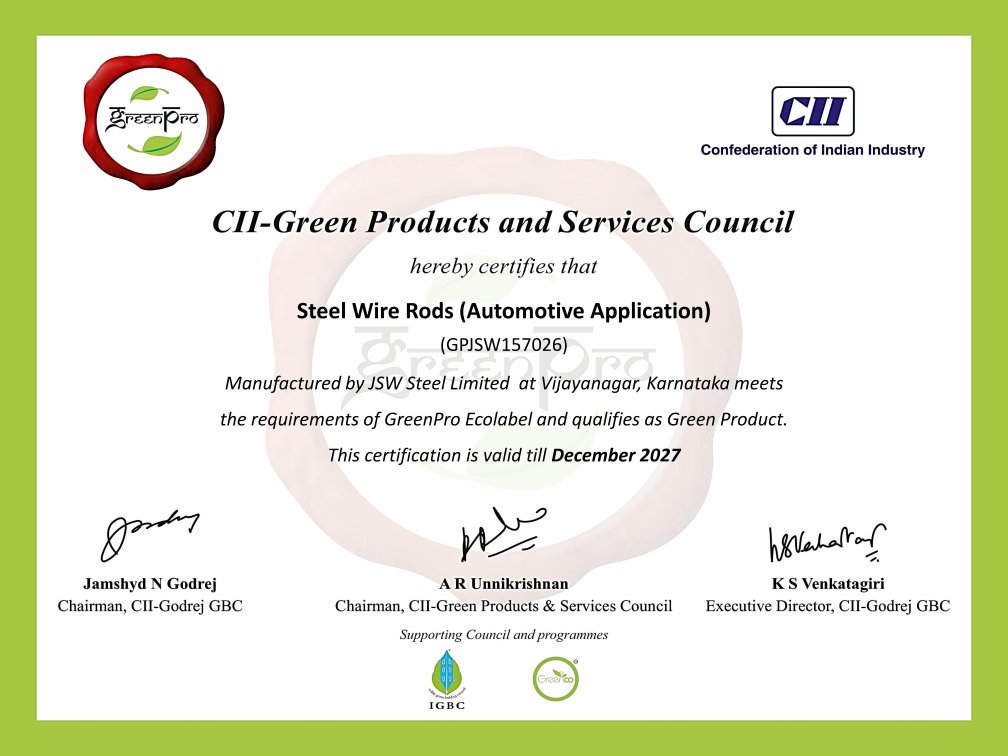
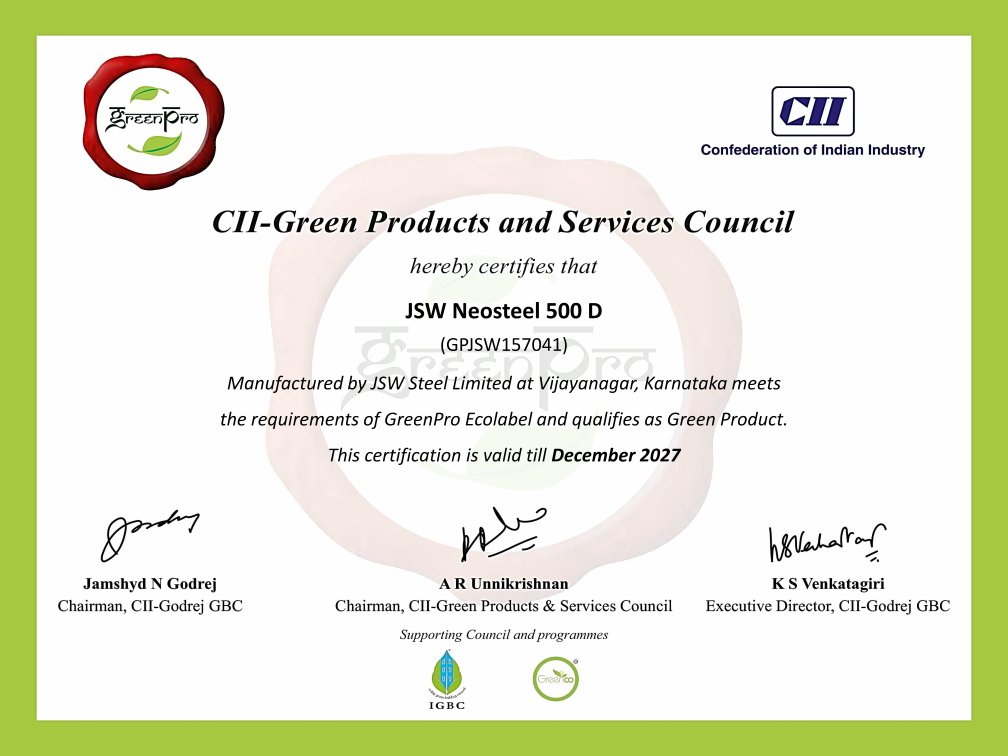
JSW Steel continues to expand its portfolio of products certified under the GreenPro Ecolabel, administered by the Confederation of Indian Industry (CII). GreenPro certification is awarded following a rigorous lifecycle-based assessment that evaluates environmental performance across the product lifecycle, including raw material sourcing, manufacturing, product use, resource efficiency, and end-of-life management. Through independent third-party verification, the certification provides credible assurance of a product's environmental attributes and supports transparent, sustainability-focused procurement decisions.
As part of its Sustainable Products Programme, JSW Steel has expanded its portfolio of GreenPro-certified products across multiple steel categories, including automotive-grade steel products and innovative construction solutions such as FE 500D and FE 550D TMT rebars. These products are developed using resource-efficient manufacturing practices and circular economy principles, including increased material efficiency, recycling, and beneficial utilisation of by-products. GreenPro-certified products support customers in reducing lifecycle environmental impacts, advancing sustainable construction and manufacturing practices, and contributing to broader decarbonisation and resource-efficiency objectives.
Several GreenPro-certified products also contribute to green building initiatives by supporting recognised sustainable building frameworks such as IGBC and LEED. By increasing the availability of independently certified steel solutions, JSW Steel enables customers to integrate sustainability considerations into procurement decisions, reduce the environmental footprint of their projects and products, and advance the transition to a low-carbon economy. For more details, please refer to our Integrated Report
At JSW, we recognize that product design, manufacturing processes, and customer usage patterns significantly influence the overall environmental footprint of a product. To evaluate these impacts comprehensively, we adopt the Life Cycle Assessment (LCA) methodology, a globally recognized approach that assesses environmental impacts across every stage of a product's life cycle, from raw material extraction and manufacturing to use, recycling, and end-of-life management.
LCA enables us to identify environmental hotspots, improve resource efficiency, reduce emissions, and support informed decision-making for sustainable product development. By taking a holistic view of environmental performance, LCA helps us enhance product sustainability while creating long-term value for customers and stakeholders.
As part of our commitment to responsible manufacturing, JSW has completed LCA studies for key products using internationally accepted life-cycle engineering methodologies. These assessments provide valuable insights that support sustainable innovation, transparent reporting, and the development of lower-impact products.
An Environmental Product Declaration (EPD) is an independently verified and registered document that transparently communicates the environmental impacts of a product throughout its life cycle. Based on a comprehensive Life Cycle Assessment (LCA), an EPD provides standardized, credible, and comparable information on a product's environmental performance, enabling customers and stakeholders to make informed purchasing decisions.
EPDs are developed in accordance with internationally recognized Product Category Rules (PCRs) and provide verified data on environmental indicators, ensuring consistency and comparability across similar products.
As a leading manufacturer in the steel and cement sectors, JSW is committed to enhancing product transparency and supporting sustainable construction practices. We are progressively implementing a group-wide EPD programme aligned with ISO 14025 and EN 15804 standards to disclose the environmental performance of our products.
JSW obtains product-specific EPDs through independent third-party verification, ensuring accuracy, credibility, and compliance with international standards. These declarations provide customers with reliable environmental information while helping us identify opportunities for resource optimization, emissions reduction, and continuous improvement across the product life cycle.
For customers in the construction sector, the use of EPD-certified JSW products can contribute toward green building certification programs such as LEED and BREEAM. By providing transparent environmental data, EPDs reinforce our commitment to sustainability and support the transition toward more sustainable infrastructure and construction practices.
This approach enables JSW to deliver products that not only meet quality and performance expectations but also support our customers' sustainability goals.
For detailed information on JSW's Environmental Product Declarations and product transparency initiatives: https://www.jsw.in/transparency-customers/
For more details, please refer to our Integrated Report
A Solution for a Sustainable Tomorrow

JSW GreenEdge is our certificate based low-carbon emission steel solution designed to offer flexible reduction in your carbon footprint. Following worldsteel's Chain of Custody Guidelines (2024) and utilizing the Book and Claim approach, GreenEdge ensures verified CO2 reductions and transparency.
JSW Steel reduces CO2 emissions by implementing additional reduction projects across its steel value chain. Only those projects that meet the additionality criteria outlined in Worldsteel's Chain of Custody Guidelines are eligible for verification.
The verified reductions are then booked and stored securely in a virtual CO2 bank monitored by a third-party auditor.
Customers purchase GreenEdge steel and are supplied with a certificate of CO2 emission reductions along with a document stating the GHG emission intensity of the steel products.
Customers can claim the carbon reductions associated with their purchased GreenEdge steel toward their sustainability targets, such as Scope 3 emissions reduction.
The system for the classification of the product as a sustainable product is aligned with Worldsteel's Chain of Custody Guidelines, based on quantified environmental performance criteria, including lifecycle greenhouse gas emissions, resource efficiency, recycled material content, and broader environmental impacts assessed across the product lifecycle, ensuring that all reductions are properly verified, tracked, and transparently accounted for. This ensures that customers can rely on the credibility of their claimed reductions. The Book and Claim system plays a crucial role in helping JSW Steel achieve its carbon neutrality goals and contributing to the transition to a low-carbon economy, all while maintaining the integrity and transparency of the environmental claims. For more details, please refer to our Integrated Report
EU CBAM is reshaping global trade. JSW Steel is here to help.
As carbon regulations evolve worldwide, emissions data is becoming an important part of doing business with European customers. Whether you export steel directly to the European Union or manufacture products that ultimately reach Europe, understanding the Carbon Border Adjustment Mechanism (CBAM) is increasingly important.
JSW Steel is committed to supporting our customers, distributors, fabricators, processors, traders and exporters by providing verified emissions information and guidance to help address emerging CBAM-related requirements.
The Carbon Border Adjustment Mechanism (CBAM) was established by the European Union under Regulation (EU) 2023/956. It applies to imports of selected carbon-intensive products into the EU, including:
CBAM aims to create a level playing field between products manufactured in the European Union and those produced in other countries, while reducing the risk of “carbon leakage” whereby production shifts to regions with less stringent climate regulations.
Under CBAM, EU importers must report greenhouse gas emissions (GHGs) embedded in imported goods and, over time, surrender CBAM certificates linked to those emissions. The compliance obligation rests with the authorised EU importer; however, accurate emissions data from producers and suppliers is essential for fulfilling these requirements.
CBAM is changing the way carbon emissions influence global trade.
For businesses supplying products to European markets, emissions information is no longer only a sustainability metric. It is becoming a business, customer and market-access requirement.
Organisations that can demonstrate verified emissions data may benefit from:
As a result, emissions performance and data transparency are becoming important commercial differentiators.
Steel is among the sectors most significantly impacted by CBAM.
Most iron and steel products covered under relevant CN Codes are within scope, including:
For these products, CBAM considers emissions generated during production as well as emissions embedded in key input materials.
EU importers are required to account for the embedded emissions associated with imported products. Where verified supplier-specific emissions data is unavailable, importers may need to rely on default values prescribed under CBAM requirements, which is significantly higher for Indian Iron and Steel Sector.
As customer expectations evolve, companies across the value chain are increasingly seeking reliable emissions information from steel producers to support their reporting requirements.
JSW Steel supports customers whose products are sold in or exported to European markets, either directly or through downstream value chains.
Our support includes:
We calculate installation-specific and product-specific embedded emissions in accordance with applicable CBAM methodologies.
Relevant emissions data is independently verified by accredited third-party verification bodies.
We support customers seeking emissions information for steel supplied by JSW Steel that may be required for CBAM-related reporting and disclosures.
Our CBAM support team can assist customers in understanding available emissions information and responding to evolving customer and market requirements.
At JSW Steel, we believe that transparency, data integrity and continuous decarbonisation are essential to building resilient and competitive value chains.
Contact our CBAM support team with details of the products and reporting requirements.
Our team reviews the request and determines the applicability and availability of relevant emissions information.
Applicable verified emissions information is compiled in accordance with available datasets and reporting requirements.
Our experts work with customers to address queries and support their understanding of the information provided.
CBAM applies to a broad range of iron and steel products identified under relevant EU customs classifications. Applicability should be assessed based on the specific product and export circumstances.
Potentially yes. Businesses supplying components, fabricated products or finished goods that ultimately enter European markets may increasingly be asked by customers to provide emissions information.
Yes. JSW Steel maintains emissions data for its operations and can support eligible customer requests with applicable verified information.
No. Compliance with CBAM remains the responsibility of the authorised importer and relevant parties in the supply chain. Customers should evaluate their specific obligations under applicable regulations.
Yes. Regulatory requirements and implementation processes may continue to develop. Businesses should regularly monitor official guidance and regulatory updates.
Need support regarding CBAM or emissions information associated with JSW Steel products?
CBAM Support Team
cbam.info@jsw.in
Our team is available to respond to enquiries and help customers better understand available emissions information and reporting expectations.
The content provided on this page is for general informational purposes only and does not constitute legal, regulatory, compliance or professional advice. CBAM obligations remain the responsibility of the authorised importer and other responsible parties. Customers should consult applicable regulations and professional advisers regarding their specific obligations. Availability of emissions information may be subject to product scope, data availability and applicable verification requirements.

Stories
Social Media


© 2026 JSW Steel. All rights reserved
Privacy Policy

