EMERGING STRONGER,
ACCELERATING GROWTH
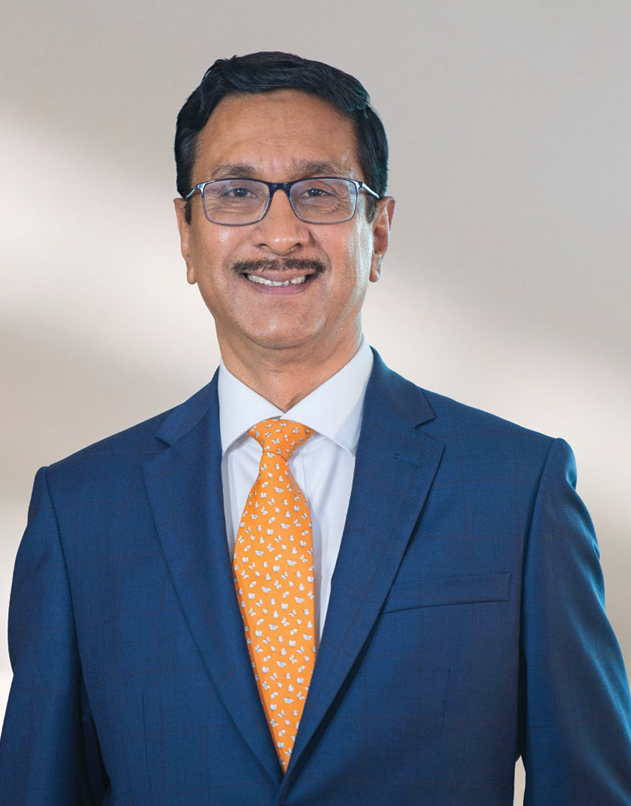
Dear Stakeholders,
FY 2025-26 saw an uncertain global landscape, marked by escalating tariffs, geopolitical tensions, and volatile commodity markets. Yet, amid this uncertainty, India’s growth story continued to demonstrate remarkable resilience and momentum. The economy expanded by 7.7%, supported by domestic consumption, a decisive push towards manufacturing, and a robust infrastructure pipeline backed by Government capital expenditure. The impact of this investment is visible across the country: highways connecting the hinterland, metro networks transforming urban mobility in cities, and new airports coming up on the nation’s aviation map.
The domestic steel sector did not merely participate in this momentum; it helped anchor it. Despite the global volatility and market uncertainties, the underlying drivers remain structural, broad-based, and enduring. The infrastructure pipeline is deep, housing demand is strong, and manufacturing continues to gather pace. What we are witnessing is not simply a cyclical upswing, this is the beginning of a new phase of India’s industrial development – one that will require an entirely different level of manufacturing capability, infrastructure creation, energy transition and industrial capacity. Steel sits at the centre of that story
The global environment, however, presented a more mixed picture. Soft domestic demand in China led to a significant surge in exports. Combined with trade restrictions in several markets, this distorted international pricing and exerted pressure on the industry. In this context, many countries implemented suitable trade measures to stem unfair steel trade. India also followed with the imposition of safeguard duties during the year, which served as an effective circuit breaker against predatory imports. As a result, imports fell and exports climbed, with India closing the fiscal year as a net exporter of steel after two years.
Delivering in a challenging environment
In a year that tested industry resilience, JSW Steel delivered a strong and disciplined performance. Our crude steel production grew 8% to 30.14 million tonnes, with operations running at a healthy 96% capacity utilisation. Sales volume increased by 12% to 29.63 million tonnes, with domestic sales growing 10% to 25.96 million tonnes. This operational momentum, sustained through the year, culminated in our highest-ever domestic sales. Our ValueAdded and Special Product sales were the highest-ever, and accounted for 61% of total sales, underscoring our strategic focus on higher-value applications that support India’s electrification, renewable energy expansion, mobility transformation, and manufacturing ambitions. We achieved 99% of our production guidance and 101% of our sales volume guidance for the year.
Our focused alignment with India’s highest-conviction growth segments continues to deliver tangible outcomes. Our highest-ever sales across the auto, renewable energy and appliances sectors reflect the strength of our investments in product quality, deep customer engagement, and a portfolio strategically aligned with India’s evolving priorities.
On the financial front, consolidated revenue exceeded ₹1,85,000 crore, with adjusted EBITDA surpassing ₹32,000 crore.
Over the past few years, we have been deliberate in strengthening the balance sheet while continuing to invest for growth. FY 2025-26 marked another important step in that journey.
The partnership with JFE Steel for our BPSL steel business has created strategic value while strengthening the financial foundations of the business. This pivotal transaction drove a step change in our balance sheet. Net debt reduced to approximately ₹54,000 crore, and leverage improving to 1.81x. We have also adopted a more prudent stance for gearing and leverage, reflecting the greater financial strength and flexibility we now carry. This strengthened financial position has been recognised in our improved credit rating outlook, and has also enabled us to recalibrate our internal thresholds for gearing and leverage, reflecting enhanced financial strength and flexibility.
Most importantly, our structural resilience was evident during the sharp correction in global steel prices in December 2025, when prices fell to one of the lowest levels seen in six years. Our EBITDA margins remained fairly resilient in this adverse pricing environment, as a result of the sustained efforts in cost optimisation, logistics transformation, raw material integration, and improvement in product mix over recent years.
Our US operations successfully reversed the previous year’s losses to deliver a positive EBITDA in FY 2025-26, proving our responsiveness to localised market dynamics. Our Italian operations also performed well, with higher capacity utilisations and EBITDA for the year.
Building the capacity India will need
At JSW Steel, we view our expansion as an integral part of India’s growth story. We are scaling our industrial capacity to 62 MT by FY 2031-32 to ensure that, as the nation builds its future, the steel that strengthens it is proudly self-reliant.
In this context, I am excited about our partnerships with JFE Steel and POSCO – not merely for the capacity they will help create, but for what they signify. These are among the most respected names in the global steel industry, and both have chosen to deepen their engagement with JSW Steel. That speaks to the credibility we have built, the capabilities we have developed, and the trust we have earned over many years.
The strategic 50:50 joint venture with JFE Steel of Japan for the BPSL business, unites JSW Steel’s domestic expertise and execution excellence with JFE’s advanced technology. This strategic partnership will expand capacities to 10MTPA, as well as add product capabilities over the long term.
Furthering our momentum, our April 2026 joint venture with South Korea’s POSCO Group details the development of a 6 million tonne per annum integrated greenfield steel plant in Odisha. These partnerships, combined with our expanding capacity across Vijayanagar, Dolvi, Salav and Paradeep, underscores our rising industrial stature. Ultimately, these two JVs unite three of the world’s leading steel producers to support India's economic growth.
Staying committed to zero-harm and a low-carbon future
As we build a larger and more complex business, I believe safety and sustainability must remain embedded in every decision we make and every action we take. These are not separate priorities—they are fundamental to how we create long-term value and strengthen the resilience of our business.
On safety, our goal remains zero harm, and we hold ourselves to that standard every day. During the year, we continued to strengthen our safety culture through a combination of technology, capacity building, and visible leadership commitment. AI-enabled solutions are helping identify risks before they become incidents, while virtual reality-based training, digital vision platforms, and structured leadership interventions are enhancing preparedness and reinforcing safe behaviours across our operations.
On the sustainability front, we continued to make meaningful progress on our decarbonisation roadmap while laying the foundation for the next generation of steelmaking. We commissioned India's first green hydrogen plant at our Vijayanagar plant and advanced our renewable energy transition, with Board approval for 2.5 GW of renewable energy capacity and 320 MWh of battery storage, of which nearly 1 GW is now operational. These investments are strengthening our pathway towards lower-carbon operations and greater energy resilience.
We are also building capabilities that will differentiate steel producers in a carbon-constrained future. During the year, we launched GreenEdge, our first low-carbon steel offering under internationally recognised chain-of-custody guidelines, while increasing external scrap utilisation by over 70% compared to the previous year. Alongside these efforts, we continue to expand lifecycle-based product assessments, increase circularity in our operations, and collaborate across the value chain to help customers reduce their carbon footprint.
Additional initiatives included biomass integration at our Salem plant, reducing approximately 19,000 tonnes of CO2 emissions, and the deployment of India's first electric locomotive for captive logistics at Vijayanagar. Collectively, these initiatives reflect our commitment to advancing operational excellence while reducing environmental impact. We aim to become net neutral in carbon emissions by 2050, and we are steadily building the technological, operational, and renewable energy foundations required to achieve it.
Innovation at the heart of what we do
Innovation has been a key lever of our execution-led growth. The steel we produce today is lighter, stronger, smarter, and engineered with far greater precision than it was a decade ago. The pace of innovation in our product portfolio continues to accelerate, with Value-Added and Special Products forming a dominant share of our sales mix, driven by sustained investment in R&D, and deepened technical engagement – allowing us to engineer advanced high-strength steels for the automotive sector, grain-oriented electrical steel for power infrastructure and EV applications, and specialised alloys for the defence industry.
Parallel to product engineering, our Industry 4.0 transformation took a major leap forward by embedding AI, machine learning, and automation directly into live operating environments. We unified our data systems through an Enterprise Data Lake and expanded our Data Products Programme to break down fragmented reporting and accelerate decision-making across our value chain. Through our internally governed TEJAS platform and specialised AI models, we are now automatically optimising process variables — achieving up to 5% energy savings in pelletising operations while reducing raw material variability.
Asset reliability and safety have been similarly transformed by technology. By deploying over 20,000 sensors under our Condition-based Monitoring Programme and leveraging Digital Twins, we transitioned from reactive to predictive maintenance, saving over 37,000 hours of downtime. Meanwhile, our enterprise-wide JSW Vision. AI platform has eliminated manual inspection dependency by actively tracking conveyor health, material sizing, and shop-floor safety and quality compliance, these integrated capabilities are delivering clear operational and commercial optimisation across our entire business ecosystem.
Nurturing a culture of ownership
When I look at what JSW Steel achieved this year, I see the commitment and dedication with which our people approach what they do every day.
We are investing in building leaders for tomorrow. We are identifying high-potential talent early, creating structured development pathways, and building a culture where learning is continuous and empowerment is real. Our digital transformation has reached our people practices as well, with technology at the core of how we manage talent, how we assess performance, and how we identify the capabilities we will need in the years ahead. I believe we have one of the strongest teams in Indian industry. Attracting, developing and retaining this talent base remains a foremost priority for the organisation.
Giving back to the communities that support us
The real measure of our success is often found not within the perimeter of our steel plants, but in the thriving communities around them. Our social initiatives are designed to match the scale of our industrial ambitions, focusing on creating sustainable, life-altering changes. By revitalising rural educational frameworks, nurturing local athletic talent to compete on the national stage, and engineering massive water conservation structures, we are actively securing the future of our host regions. For us, community engagement is a core responsibility — an ongoing commitment to ensure that our economic progress directly translates into a better quality of life for all.
The journey ahead
As I look ahead, what gives me genuine confidence is the scale and variety of economic activity unfolding across India today. We are witnessing a steady rise in household incomes, rapid urbanisation, and a clear aspiration for better infrastructure, modern housing, and seamless mobility. Every single one of these everyday aspirations is, at its core, a steel story.
This demand is not cyclical—it is structural, anchored in the fundamental building blocks of a modern economy. From renewable energy grids and data centres to the expansion of railways, ports, and transit networks, these investments reflect the true scale of India’s national ambitions. For the coming fiscal, we expect domestic steel demand to continue growing at a healthy pace.
JSW Steel is well positioned to serve this expansion, backed by a strong product portfolio, secure raw material integration, and a resilient balance sheet. In a global landscape where, traditional industrial markets are slowing down, India stands out as a clear beacon of long-term demand visibility. We intend to participate meaningfully in this opportunity, while remaining disciplined in how we grow. By maintaining leverage within our conservative internal thresholds, we ensure the flexibility to fund a significant share of our future growth through internal cash generation.
Everything we are building towards is ultimately powered by people—our employees, customers, partners, suppliers, and the communities around our operations. I thank each of our stakeholders for the trust, commitment, and belief you continue to place in JSW Steel. I remain deeply grateful to the entire JSW team, whose energy, ownership, and pride in what they build every day continue to drive the Company forward. I extend my sincere appreciation to our stakeholders for their trust and long-term conviction in our journey.
We remain committed to building a world-class steel enterprise that is globally competitive, domestically rooted, and unwaveringly focused on long-term value creation. As India rises, JSW Steel is proud to rise with the nation.
We are building for a much larger future— and I firmly believe JSW Steel is only just getting started.
With regards,
Jayant Acharya
Joint Managing Director and CEO