DIVERSITY,
EQUITY AND
INCLUSION
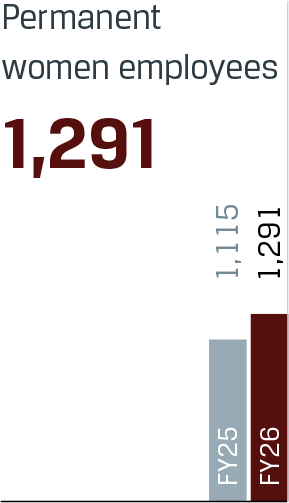
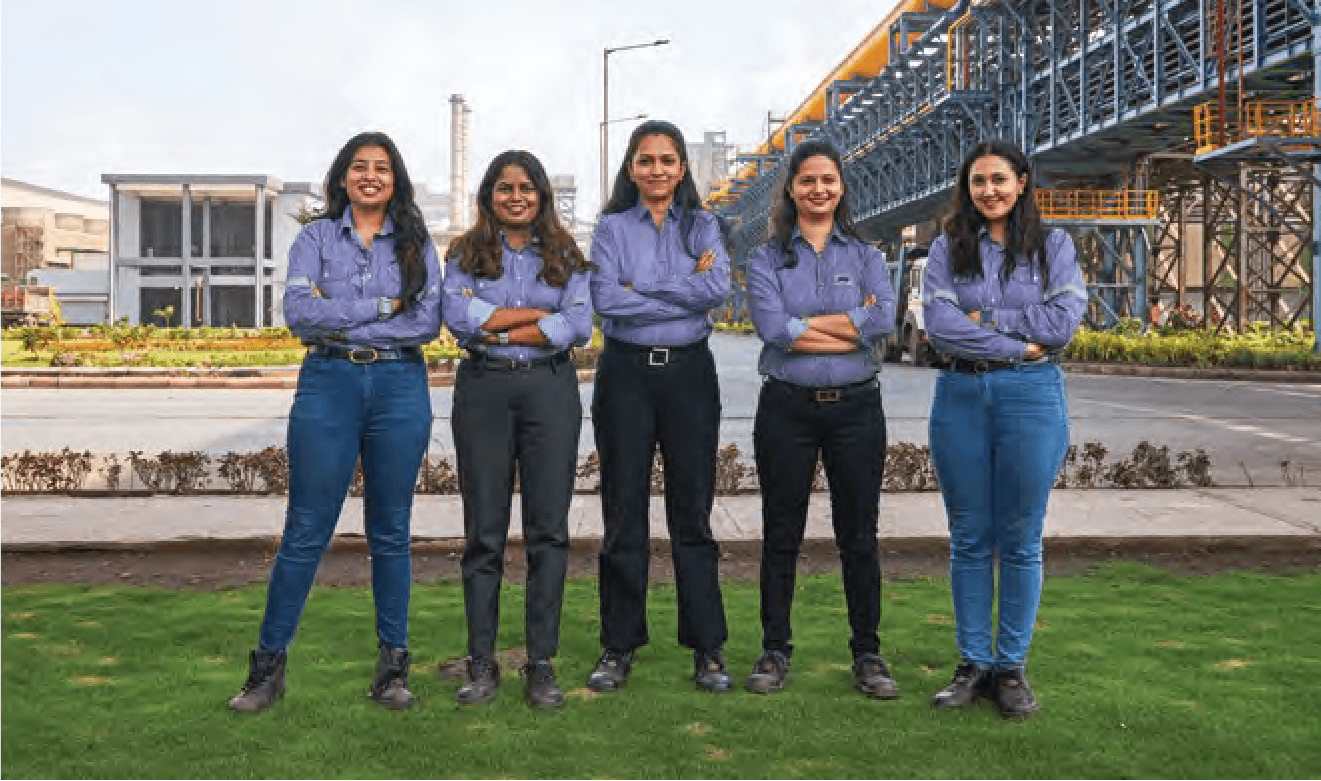
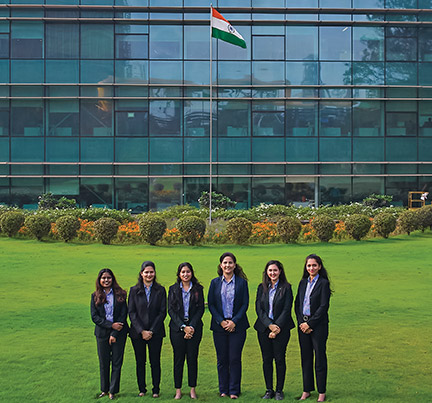
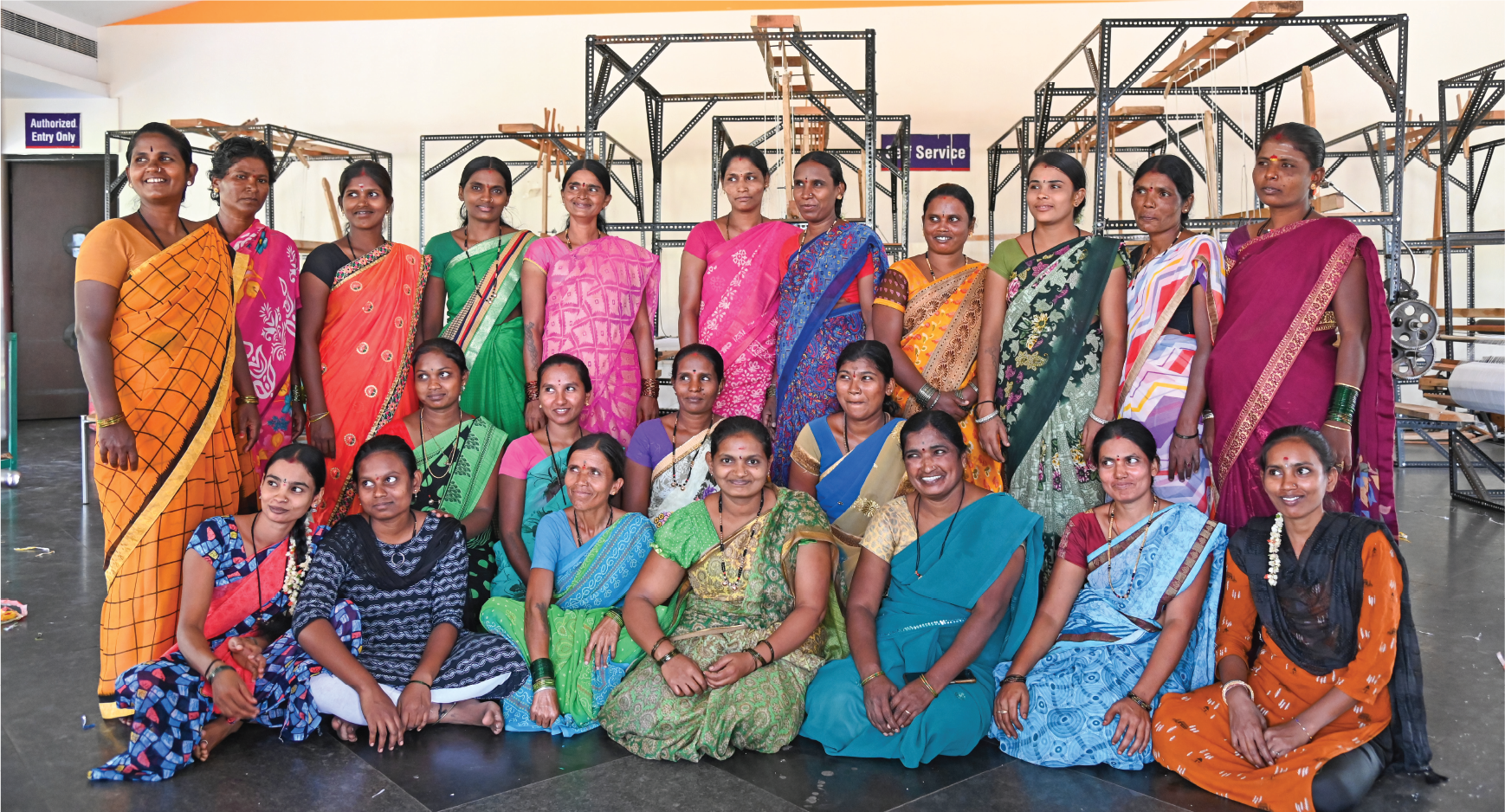
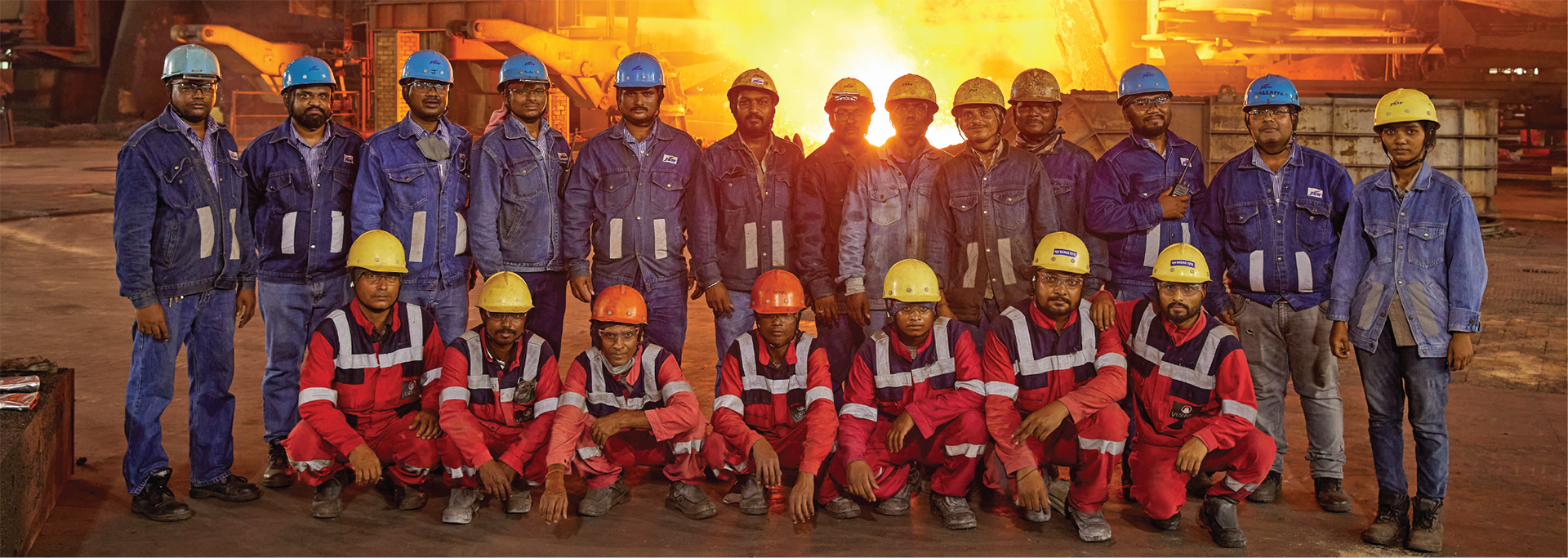
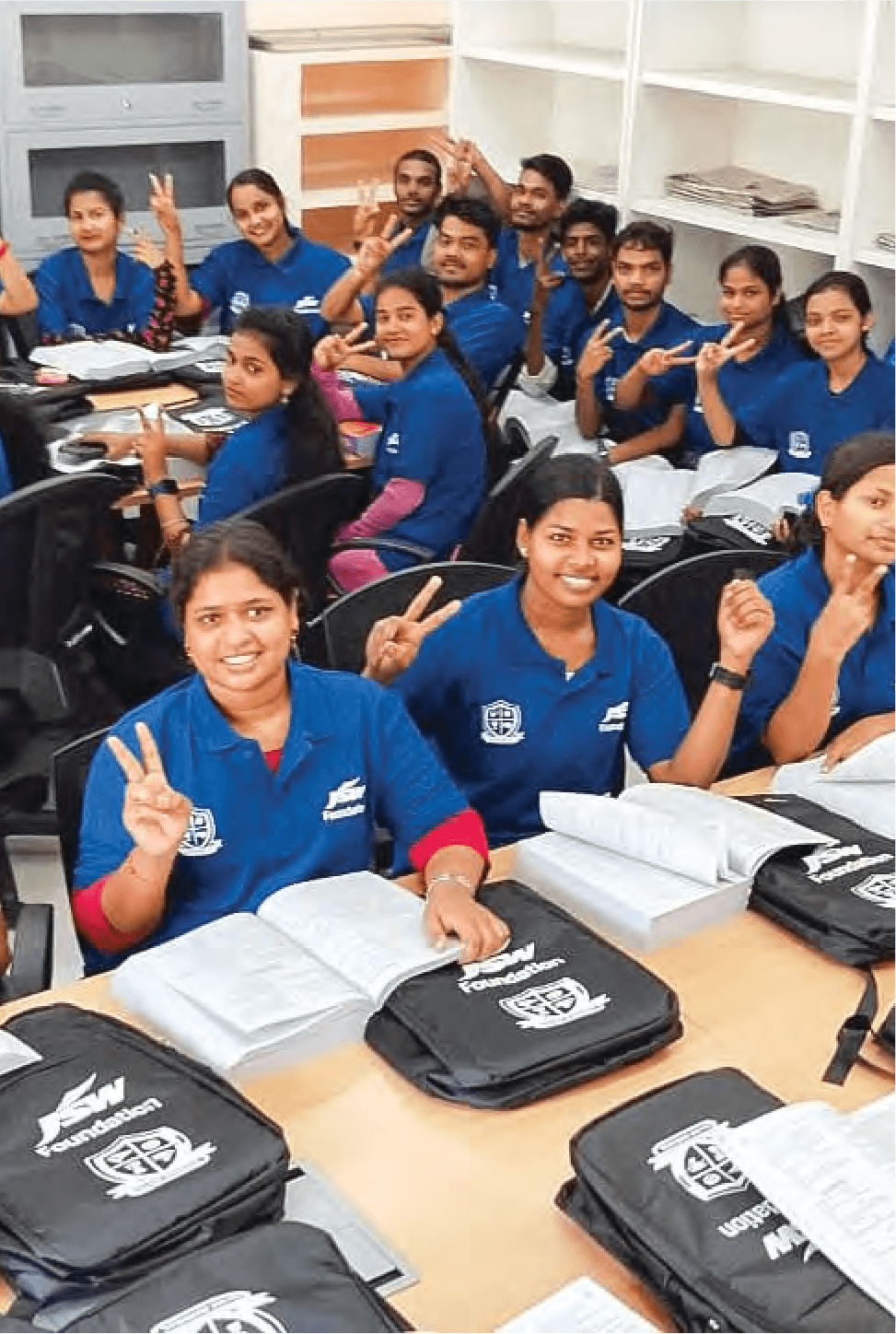
During the year, women’s
representation increased to 8%,
supported by inclusive hiring
practices, targeted campus outreach,
and stronger women focused
leadership interventions.
Capitals interlinkages
UNSDGs
At JSW Steel, Diversity, Equity and Inclusion (DEI) remains a core pillar
of our People First philosophy and a key driver of sustainable business
growth. We are committed to fostering a workplace culture rooted in
respect, fairness and equal opportunity, one where every individual is
empowered to contribute, grow and succeed.
Our DEI framework provides a structured and forward-looking approach
towards building a more inclusive organisation. While we embrace
diversity across multiple dimensions, we have placed a strong and
deliberate emphasis on advancing gender diversity, recognising
it as a critical enabler of innovation, organisational performance
and balanced decision-making.
Strategic focus on
gender diversity
We continue to make steady progress in
enhancing gender representation across
all levels of our organisation. We have
adopted a phased approach to increasing
women’s participation in the workforce,
with a clear focus on:
- Hiring 30% women across entrylevel programmes such as GET
and internships
- Progressively improving overall
gender diversit
- Strengthening representation across
middle and senior leadership roles
Our recruitment practices are designed
to ensure diverse candidate pipelines,
inclusive hiring panels and bias-aware
decision-making processes.
Building inclusive
leadership pipelines
Through targeted interventions such as
the Springboard – Women’s Leadership
Programme, we continue to invest
in developing the women leaders of
the future. Initiatives including career
conversations, cross-functional projects,
job rotations and mentorship platforms are
enabling women employees to accelerate
their professional growth and take on
leadership responsibilities.
Enabling an inclusive
workplace
We have institutionalised a range of
policies and practices to support inclusion,
flexibility and employee well-being,
including:
- Comprehensive maternity and
paternity benefits, along with returnto-work support
- Childcare facilities and flexible
working arrangements
- A robust Employee Assistance
Programme (JSW We Care) focused on
emotional and mental well-being
In addition, fairness and equity are
embedded within our performance
management processes, ensuring equal
growth opportunities for all employees.
Driving awareness and
accountability
We actively promote an inclusive
culture through:
- Regular sensitisation workshops on
unconscious bias and respectful
workplace behaviour
- POSH (Sammaan) training and
ongoing communication campaigns
- Capability-building programmes for
managers to support inclusive hiring,
development and team management
Leaders and managers are held
accountable for advancing the DEI agenda
and are recognised for their contributions
towards building inclusive teams.
Governance and
measurement
Our DEI initiatives are governed through
structured councils at both corporate
and plant levels, supported by strong
leadership sponsorship to ensure effective
implementation. Progress is tracked
through defined metrics, including:
- Representation of women
across levels
- Diversity in hiring
- Employee engagement
and satisfaction among
women employees
These indicators are reviewed periodically
by the Executive Committee to ensure
continued alignment with organisational
priorities and long-term goals.
THE JSW STEEL
DIVERSITY COUNCIL
The JSW Diversity Council plays a pivotal
role in strengthening an inclusive
workplace by guiding our organisation’s
Diversity, Equity and Inclusion (DEI)
framework. Its efforts are focused on
building a workforce that reflects diversity
across gender, generations, educational
backgrounds and experiences. As part
of our Company’s ‘Better Everyday’
commitment, the Council drives initiatives
aimed at increasing women’s participation
across roles. Through these initiatives, the
Council continues to support the creation
of a more equitable, progressive and
inclusive workplace.
JSW SPOTLIGHT
JSW Spotlight is our Company’s flagship recognition and rewards platform, designed to
bring employee achievements and appreciation to the forefront. It enables both peer-topeer and
manager-led recognition, while also driving engagement through awareness
sessions, contests and awards across business units. The platform plays a significant role
in celebrating diverse talent, including dedicated initiatives that recognise and highlight
the contributions of women employees. By fostering a consistent and visible culture
of recognition, JSW Spotlight strengthens employee engagement and supports a more
connected, motivated and high-performing workforce.
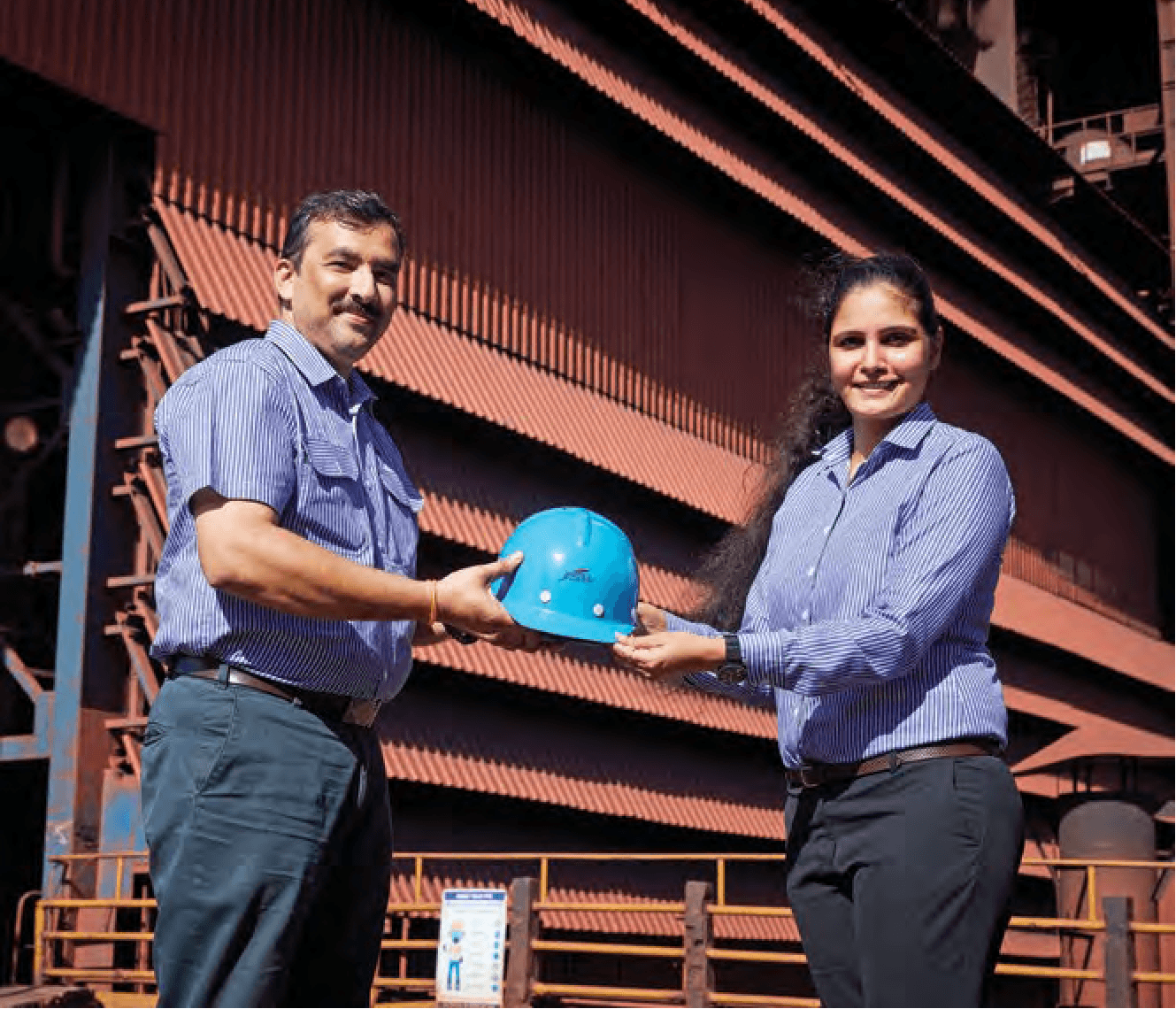
JSW – She Leads Programme
The #SheLeads recognition campaign was launched on the JSW Spotlight platform to
celebrate and acknowledge the contributions of women employees across JSW business
units. Conducted in March 2026, the campaign enabled a defined group of managers to
recognise women team members by sharing #SheLeads e-cards aligned with JSW’s five
core values - Commitment, Courage, Agility, Collaboration and Compassion.
At the conclusion of the campaign, recognitions were evaluated based on the number
received and their alignment with organisational values. The top 100 women employees
were identified and recognised for their contributions. Winners received merchandise,
vouchers and recognition points credited to their Spotlight accounts. The initiative
successfully highlighted inspiring contributions, fostered a culture of appreciation and
showcased the impact of women employees across our Company.
Top 100
Women were identified and recognised for their contributions
Great People Manager
(GPM)
The Great People Manager (GPM) initiative
is a nomination-based recognition
programme designed to celebrate
managers who demonstrate exceptional
people leadership. Employees across our
organisation were invited to nominate their
managers, creating a strong bottom-up
approach to recognition based on real
experiences and impact. A total of 661
managers were nominated and recognised
through this initiative.
The programme honoured leaders who
consistently foster team development,
mentorship, empathy, engagement and
alignment with organisational values.
Shortlisted managers were recognised
through a structured rewards and
recognition framework, reinforcing
clear benchmarks for people leadership
excellence at JSW. The initiative
underscored the importance of leadership
that places people at the centre and
inspires teams to perform at their best.
661
Managers were nominated
and recognised
Cheers
‘3 Cheers’ is a year-round peer-to-peer
recognition programme designed to
embed appreciation into our Company’s
everyday culture. The initiative enables
employees across all levels and functions
to recognise one another in real time,
making appreciation more frequent,
inclusive and accessible. Through this
programme, over 2,453 recognitions were
shared, fostering a culture of appreciation
and positive reinforcement across
the organisation.
By encouraging employees to
acknowledge both everyday contributions
and significant achievements, the
initiative strengthens cross-functional
collaboration, builds stronger workplace
relationships and promotes a positive
feedback culture. Over time, ‘3 Cheers’
has successfully transformed recognition
from a periodic activity into a continuous
habit, contributing meaningfully to higher
employee engagement and a more
supportive work environment.
2,450+
Recognitions were shared
Success stories of women employees
Sharing women’s success stories across our Company helps inspire aspiration and
confidence by highlighting relatable role models who are excelling in core and operational
roles. These stories demonstrate how our values - Commitment, Courage, Agility,
Collaboration and Compassion are brought to life every day through the achievements
and journeys of our people.
By bringing these experiences to the forefront, we help challenge long-standing
stereotypes, encourage more women to pursue leadership and technical opportunities,
and create a stronger sense of possibility across the workforce. At the same time,
celebrating these accomplishments highlights the value that diverse perspectives
bring to innovation, collaboration and business outcomes.
Showcasing such stories also strengthens our employer brand and reinforces
our commitment to building a workplace where talented women feel supported,
recognised and motivated to grow and contribute meaningfully.

JSW’s ‘We Care’
JSW We Care is an initiative designed to support the mental health and overall well-being
of employees. The programme provides a safe and confidential platform through which
employees can seek guidance and professional support for personal, emotional or
work-related concerns.
The awareness sessions conducted under the programme aim to introduce employees
to the We Care initiative, highlight the range of support services available and help
them understand how these resources can be accessed with complete confidentiality.
The initiative reflects JSW’s commitment to fostering a supportive workplace that
prioritises employee well-being and holistic development.
Employee Assistance
Programme (EAP)
The Employee Assistance Programme
(EAP) at JSW continues to play an
important role in supporting the overall
well-being of employees and their
families. During the year, the programme
witnessed strong engagement, reflecting
growing awareness and trust in the
services provided. More than 3,729 new
employees registered for the programme,
while over 430 counselling sessions
were conducted to support individuals
dealing with personal, emotional and
professional challenges.
The programme also saw encouraging
participation from employees’ families,
highlighting its positive impact beyond
the workplace. A total of 48 family
members registered for the programme,
with 25 actively availing counselling
support. In addition, five maternity cases
were successfully onboarded through
the programme, demonstrating JSW’s
continued commitment to supporting
employees through important life stages.
These numbers reflect the growing
acceptance of mental health and
wellness support within our organisation.
The increasing utilisation of the EAP
underscores JSW’s efforts to create
a supportive and inclusive work
environment where employees and their
families feel comfortable seeking guidance
and assistance whenever needed.
Through such initiatives, our Company
continues to strengthen its focus on
holistic well-being, helping employees
maintain a healthy balance between
their personal and professional lives.
30 Day DEI Challenge
The DEI Challenge was launched across
all locations in March 2026 as part of our
ongoing efforts to strengthen awareness
around Diversity, Equity and Inclusion
(DEI). The initiative was designed to
engage employees in a fun and interactive
manner while encouraging a deeper
understanding of inclusive workplace
practices. Employees participated in more
than 35 interactive online games focused
on various aspects of diversity, equity and
inclusion, enabling them to learn while
actively engaging with the subject. The
challenge also encouraged employees
to contribute towards fostering a more
inclusive, respectful and collaborative
workplace culture. To further drive
participation and enthusiasm, the top 100
employees who successfully completed all
the games were rewarded with vouchers
in recognition of their active involvement
and commitment to the initiative.
35+
Interactive online games in
which employees participated
Top 100
Employees who successfully
completed all the games were
rewarded with vouchers
DEI sensitisation and
allyship for inclusive
leadership
DEI sensitisation workshops
These workshops are designed to create
awareness around unconscious bias,
privilege, microaggressions and inclusive
language. Tailored sessions are conducted
for employees, managers and leadership
teams to strengthen understanding
and encourage more inclusive
workplace behaviours.
Allyship in action
This initiative encourages active allyship
across all levels of the organisation by
empowering individuals to advocate
for equity and inclusion. It promotes
behaviours such as speaking up,
creating safe spaces and amplifying
underrepresented voices to foster
a more inclusive workplace culture.
Inclusive leadership programmes
These programmes equip leaders with
the mindset and capabilities required to
lead diverse teams effectively. Key focus
areas include empathy-driven leadership,
psychological safety and equitable
decision-making, enabling leaders to build
more collaborative and inclusive teams.
Strengthening inclusion through
capability building
At JSW, we remain committed to
embedding Diversity, Equity and Inclusion
(DEI) into our organisational culture. As part
of this commitment, we have introduced
a series of structured workshops aimed
at deepening employees’ understanding
of inclusive practices and equipping them
with the tools required to foster a more
open, respectful and equitable workplace.
These workshops are designed
to build awareness, encourage
behavioural change and strengthen
inclusive leadership across all levels
of our Company.
DEI sensitisation workshop
(For all employees)
This workshop focuses on building
foundational awareness and a shared
understanding of Diversity, Equity and
Inclusion (DEI) across the organisation.
Key focus areas include:
- Understanding the dimensions and
definitions of DEI
- Exploring the business case for DEI
within JSW
- Identifying challenges faced by
diverse talent groups
- Recognising individual and systemic
barriers to inclusion
Allyship and inclusive leadership
workshop
This advanced workshop is designed
to enable leaders to actively foster
inclusion within their teams. Key areas
covered include:
- Understanding microaggressions and
their impact in the workplace
- Building inclusive leadership
behaviours and mindsets
- Practical tools to foster a culture
of belonging
- Defining the role and different forms
of active allyship
The sessions are facilitated by
experienced DEI practitioners and
incorporate interactive discussions,
real-world scenarios and actionable
frameworks to ensure meaningful
learning and practical application.
Through these focused interventions,
JSW continues to strengthen its
inclusive culture by building awareness,
enhancing leadership capability and
empowering employees to contribute
towards a more equitable, respectful
and inclusive workplace.
Women of future 2.0:
Building a future-ready leadership pipeline
At JSW, we believe that a diverse and inclusive leadership pipeline is critical to driving
sustainable growth and innovation. Women of Future 2.0, one of our flagship leadership
development initiatives, reflects this commitment by empowering aspiring women leaders
to grow with confidence, capability and influence.
Designed as a structured seven-month journey, the programme focuses on strengthening
leadership. It equips participants with the mindset and capabilities required to navigate
complexity, lead with impact and step into future-ready roles.
The programme brings together high-potential women employees who demonstrate
strong performance, leadership potential and a growth mindset. Through a blend of
immersive learning interventions, mentorship from senior leaders and action-learning
projects, participants gain practical exposure to real business challenges while
strengthening their strategic and leadership capabilities.
Women of Future 2.0 is designed to:
- Build self-awareness, resilience and confidence
- Strengthen empathetic and accountable leadership
- Enhance strategic thinking and business decision-making
- Develop executive presence for larger leadership roles
- Enable experiential learning through action-driven projects
Building on the strong foundation of the initiative, we have already engaged more than 200
women employees across JSW, reflecting both the scale and impact of the programme.
A continuous journey
At JSW Steel, we believe that diversity is reflected through representation, while
inclusion is experienced through a genuine sense of belonging. We remain committed
to continuously strengthening our policies, practices and organisational culture to build
a truly inclusive workplace, one that values diverse perspectives and leverages them to
drive innovation, collaboration and long-term success.
KEY STRATEGIES FOR HEALTH AND SAFETY
In FY 2025–26, our health and safety agenda was driven by a structured, four-pillar
framework anchored to Vision 2030: Zero Harm, comprising Effective Leadership, Robust
Systems, Competent Workforce and Digitalisation & Innovation. Each pillar represents
a mutually reinforcing dimension of safety excellence, collectively building towards a
workplace where every individual returns home safe, every day.


Effective Leadership
Visible, accountable and committed
leadership is the bedrock of any highperforming safety culture. At JSW Steel,
safety leadership is not confined to the
EHS function; it is a shared responsibility
that extends across every level of
management, from the Board and senior
executives to line managers and frontline
supervisors. Our Company’s approach
rests on the principle that leaders who
are actively present on the shop floor,
who participate in safety observations,
and who model safety-conscious
behaviour, drive the strongest outcomes.
In FY 2025-26, several structured
initiatives reinforced this philosophy.
Safety observations and frontline
accountability
Safety observations are among the most
powerful leading indicators of cultural
maturity. They signal an organisation’s
ability to identify and address unsafe
conditions and behaviours proactively
before they escalate into incidents.
During FY 2025-26, over 5 lakh safety
observations were reported across the
JSW Group, a scale that reflects deep
organisational engagement with proactive
hazard identification. Senior officer-level
employees were institutionally embedded
into structured safety observation and
review cycles, ensuring that accountability
for safety is not merely delegated but
personally owned at the highest levels.
This integration of leadership into routine
safety processes reinforces the message
from the boardroom to the shop floor that
safety is a non-negotiable organisational
priority. Findings from these observations
are used to shape behavioural
interventions, identify systemic gaps
and drive continuous improvement.
Lead the Change –
Safety as a Core Value
Transforming safety culture requires
moving beyond procedural compliance
towards a deeply internalised set of
values. In FY 2025–26, we launched the
‘Lead the Change – Safety as a Core Value’
programme through which over 1,100
employees across all Steel and Coated
Sites were trained to regard safety not
as an externally imposed obligation but
as a personal and organisational value.
This initiative builds on the premise that
durable safety performance is driven by
intrinsic motivation where each individual
becomes an active advocate for safety in
their own work environment.
Leadership Gemba Walks
Gemba Walks where senior leaders
physically visit the point of work to
observe, engage and act are a cornerstone
of our visible leadership model. During
FY 2025–26, structured Leadership
Gemba Walks were conducted across all
major sites, enabling senior management
to directly observe ground conditions,
engage in dialogue with workers, identify
safety gaps in real time and model safety-conscious behaviours. These walks serve
as a powerful mechanism for breaking
down hierarchical barriers and creating a
two-way conversation about safety.
JSW Safety Quizathon
Building awareness of safety principles at
scale requires engagement that is both
broad and meaningful. During FY 2025–26,
the JSW Group conducted a companywide Safety Quizathon that engaged
over 13,000 employees across sites and
functions. The Quizathon was designed
not merely as a knowledge test but as an
interactive platform to promote ownership
of safety principles, share learnings and
build a shared vocabulary around safe
behaviours. By making safety awareness
engaging and inclusive, the initiative
strengthened the organisation’s collective
safety consciousness.
JSW Safety Assurance Protocol
(JSAP)
In FY 2025–26, we launched the JSW
Safety Assurance Protocol (JSAP), a
comprehensive, structured assessment
framework applied across all Steel and
ISP sites. JSAP provides a systematic
mechanism for evaluating safety
governance maturity, compliance with
Group Health and Safety Standards
and the effectiveness of site-level
safety management systems. By
establishing a common baseline for
safety assurance, JSAP enables the
identification of improvement priorities
and drives consistent, high-quality safety
management across the organisation’s
diverse operational footprint.
Global engagement -
worldsteel SHCO-17
Our leadership credentials in safety
were further validated on the global
stage in FY 2025-26, when our Company
presented our holistic Contractor Safety
Management framework at the worldsteel
Safety, Health and Community Outreach
(SHCO-17) conference in Istanbul. This
presentation demonstrated our progress
on the Vision 2030: Zero Harm journey
to a global audience of steel industry
peers, underscoring our ambition to
be a global benchmark for health and
safety performance in the metals and
mining sector.

Robust Systems
World-class safety performance is built
on governance structures, operational
systems and standardised processes
that are consistent, transparent,
auditable and designed for continuous
improvement. Robust systems ensure
that safety management is not dependent
on individual effort or circumstance but
is institutionalised into the fabric of how
our Company operates. In FY 2025-26, we
made significant advances across each of
our key system dimensions.
Five Group level safety
subcommittees
Effective governance requires specialised
oversight across distinct safety domains.
In FY 2025–26, we institutionalised five
Group-level Safety Subcommittees,
each providing expert-driven leadership
across a critical area of the safety
management system:
- Safety Observations & Audit (SO&A) —
Overseeing the quality and coverage of
frontline safety observations, planned
inspections and cross-functional
audits to identify systemic gaps and
drive corrective action.
- Process Safety Management (PSM) —
Governing process hazard analyses,
management of change protocols and
process safety information to prevent
major industrial incidents at highrisk facilities.
- Incident Investigation —
Ensuring thorough, unbiased and
learning-focused investigation of
incidents and near-misses, driving
root cause elimination rather than
symptom-level correction.
- Contractor Safety Management
(CSM) — Standardising the
assessment, onboarding, monitoring
and performance management
of contractors, who represent
a significant portion of the
total workforce.
- Standards, Rules & Procedures
(SR&P) — Developing, reviewing and
maintaining Group Health and Safety
Standards to ensure they reflect best
practices, legal requirements, and
operational realities.
These subcommittees operate as standing
bodies with defined mandates, meeting
cadences and escalation pathways,
creating a structured governance
architecture that ensures each domain of
safety management receives dedicated,
expert attention.
Connected workers (Rakshak) –
digital field intelligence
The Connected Workers initiative, branded
as ‘Rakshak’, represents our commitment
to harnessing real-time digital intelligence
for frontline safety management. The
platform equips frontline workers and
supervisors with mobile-enabled tools for
safety observations, permit management and hazard reporting, creating a live,
data-rich picture of safety conditions at
the point of work.
In FY 2025–26, the Rakshak pilot at
the Coke Oven unit of Dolvi Works was
successfully completed and is now being
scaled across the full Dolvi Steel facility,
with planned coverage extending to
approximately 14,000 personnel, making
it one of the most extensive connected
worker deployments in the Indian steel
industry. In parallel, a pilot deployment
was initiated at SMS#2 of Vijayanagar
Steel, setting the stage for further
Group-wide rollout. The platform enhances
ground-level visibility, reduces response
times to safety alerts and provides
management with actionable data
to drive proactive interventions.
Bow-Tie Barrier Management
Process safety management at complex
industrial facilities requires a structured
methodology for understanding,
monitoring and strengthening the barriers
that prevent major accidents. We deployed
the Bow-Tie Barrier Management
methodology across Vijayanagar, Dolvi,
BPSL and Salem, supported by expert-led
training programmes. The Bow-Tie model
enables the systematic identification of
top process safety events, the mapping
of preventive and mitigative controls
(barriers), and the assessment of
barrier effectiveness.
This approach moves safety management
beyond incident response towards
proactive risk control, ensuring that
critical barriers are maintained, tested,
and continuously improved. By embedding
Bow-Tie analysis into site safety reviews,
we have significantly enhanced our ability
to prevent major process safety incidents
and protect both people and assets.
PQA and CARES Audits for
Contractors
Contractors represent a substantial
proportion of our operational workforce
and their safety performance is integral
to our Company’s overall safety record.
In FY 2025-26, Pre-Qualification
Audits (PQA) and CARES (Contractor
Assessment and Rating for Excellence
in Safety) audits were completed for
over 3,500+ contractors.
These audits evaluate contractors
against rigorous criteria including safety
management systems, training standards,
equipment compliance, incident history
and supervisory capability. The outcomes
drive contractor selection, performance
improvement plans and where necessary,
deselection of non-compliant vendors.
This systematic approach to contractor
safety governance ensures that our safety
standards are embedded throughout our
extended value chain.
Progressive Consequence
Management (PCM) framework
Consistent enforcement of safety rules
is essential to sustaining a culture
of accountability. In FY 2025-26, a
Progressive Consequence Management
(PCM) framework was standardised
across all ISPs and Coated units. The
PCM framework establishes a structured,
transparent and graduated approach
to addressing safety violations from
coaching and counselling for minor
infractions to stronger measures for
repeat or severe violations.
By ensuring that consequences are
proportionate, predictable and fairly
applied, the PCM framework reinforces
the message that safety rules are
non-negotiable while also ensuring
that interventions are constructive and
oriented towards behaviour change
rather than punitive. This standardisation
eliminates inconsistency across sites and
strengthens the integrity of the safety
management system.
Safety Reward and Recognition
Guidelines
Positive reinforcement is as important as
consequence management in shaping
safety behaviour. In FY 2025–26, Groupwide Safety Reward and Recognition
Guidelines were established to
institutionalise a consistent framework
for recognising exemplary safety
contributions across all sites. These
guidelines ensure that individuals and
teams who demonstrate outstanding
safety leadership, innovation, or
performance are recognised in a timely,
meaningful and visible manner-reinforcing
the behaviours the organisation seeks
to promote and creating role models for
the broader workforce.
National Safety Week 2026 and
Road Safety Week
Our commitment to safety culture is
reflected in how we celebrate and
engage our workforce on safety themes
throughout the year. In FY 2025–26,
National Safety Week 2026 was observed
across all sites with a rich programme of
quizzes, awareness video screenings,
safety skits, VR experience sessions
and reward-based activities, all aligned
to the theme ‘Safety and Well-Being are
the Drivers for Crucial Change’. Road
Safety Week was similarly observed with
targeted campaigns reinforcing road
safety awareness for employees and
contractors. These events serve not only
to commemorate safety milestones but
also to sustain year-round momentum
and create shared experiences that
strengthen collective safety ownership.

Competent Workforce
A Zero Harm workplace can only be
achieved when every member of the
workforce from senior engineers to
entry-level contractors, possesses the
technical knowledge, practical skills and
behavioural competencies to perform their
work safely. Our workforce development
strategy is therefore grounded in a
continuous cycle of assessment, targeted
training and practical reinforcement,
ensuring that competence is built, verified
and sustained over time. In FY 2025–26,
we significantly expanded the scale
and sophistication of our workforce
development interventions.
Skill and competency
assessments at scale
In FY 2025–26, over 78,000 workmen
underwent structured skill and
competency assessments, a
transformational increase from the 2,012
assessed in FY 2024–25, reflecting our
Company’s decisive commitment to
building a comprehensively assessed and
verifiably competent workforce. These
assessments cover critical safety domains
including Lockout Tagout, Work at Height,
Scaffolding, Machine Guarding, Conveyor
Safety, Electrical Safety, Road Safety,
Contractor Safety Management, Confined
Space and Crane Safety evaluating
both technical knowledge and practical
application skills.
The outcomes of these assessments
directly inform personalised training
interventions, ensuring that skill gaps are
addressed in a targeted and resourceefficient manner and that each worker
receives the specific development they
need to perform their role safely.
Subject Matter Expert (SME)
Programme
Deep technical expertise is essential
to the credibility and effectiveness
of our safety management system.
In FY 2025-26, the Subject Matter Expert
(SME) programme launched in July
2024 certified over 3,000 employees
across 15 Group Health and Safety
Standards, encompassing critical areas including Lockout Tagout, Work at Height,
Scaffolding, Machine Guarding and
Conveyor Safety, among others.
The programme also certified over
300 ‘Train the Trainer’ (ToT) facilitators,
building an internal training infrastructure
capable of sustaining and scaling safety
competency development without
dependence on external resources.
This creates a self-reinforcing ecosystem
of expertise where certified SMEs and
trainers continuously build the capability
of their peers and the broader workforce.
Process Safety Competency
Development Programme
Process safety, the discipline of
preventing catastrophic incidents
arising from the unintended release of
energy or hazardous materials, requires
a specialised and advanced level of
technical competency. In FY 2025-26, we
launched a Process Safety Competency
Development Programme in strategic
partnership with dss+ (formerly DuPont
Sustainable Solutions), a globally
recognised leader in process safety
consulting and training.
This programme focuses on building
deep technical capability in process
hazard analysis, layer of protection
analysis, management of change and
process safety auditing, equipping
O&M and HSE professionals with the
skills to identify and manage process
safety risks at our complex, high-hazard
manufacturing facilities.
TapRooT® Advanced RCA Team
Leader Training
The quality of incident investigation is one
of the most significant determinants of an
organisation’s ability to prevent recurrence.
Superficial investigations that identify
proximate causes without addressing
underlying systemic factors create a false
sense of closure and leave root causes
intact. In FY 2025–26, we equipped
119 O&M and HSE professionals with TapRooT® Advanced Root Cause Analysis
(RCA) Team Leader Training, a globally
recognised methodology for structured,
comprehensive incident investigation.
TapRooT® provides investigators with a
systematic framework for tracing incidents
back to their root causes, whether in
human factors, management systems,
equipment or work environment and
developing corrective actions that address
these causes at their source. By building
this capability internally, we ensure
that every significant incident receives
a thorough, unbiased investigation
that drives genuine learning and
lasting improvement.
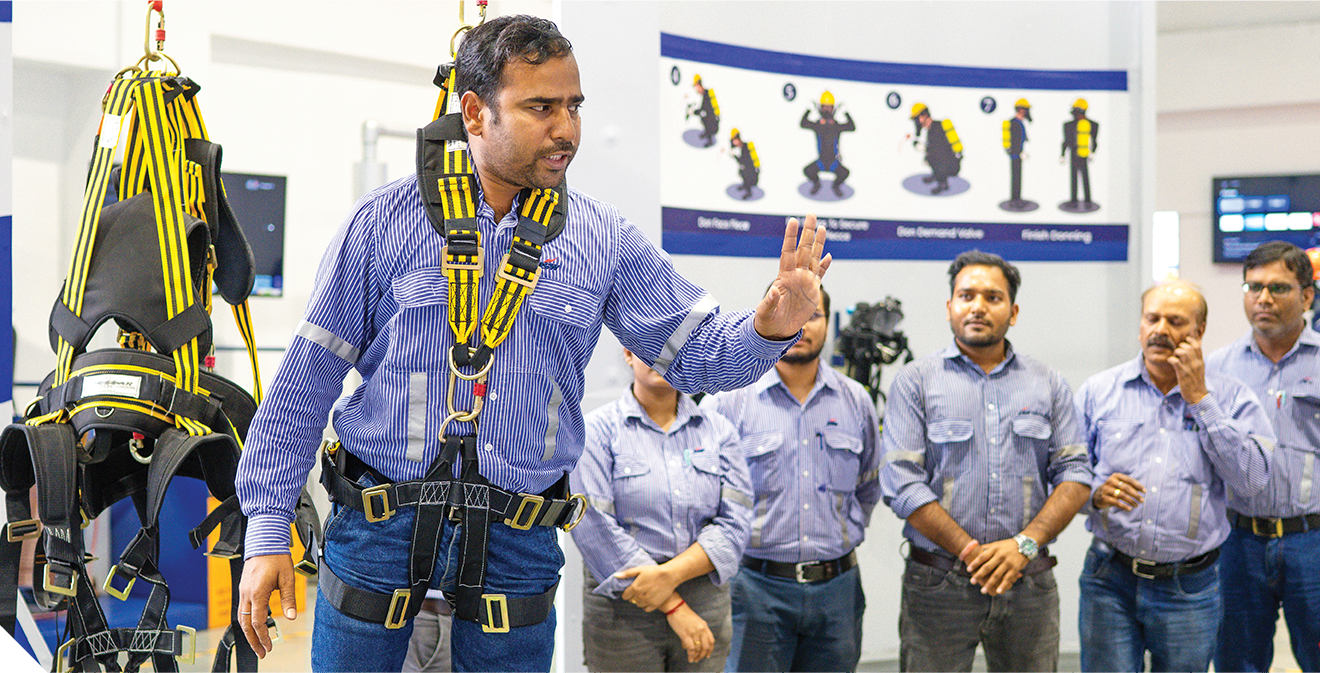
Safety Experience Centres
Traditional classroom-based safety
training is often insufficient to prepare
workers for the hazards they will encounter
in real-world industrial environments. We
have addressed this limitation by investing
in state-of-the-art Safety Experience
Centres at Vijayanagar, Dolvi, BPSL and
Salem Works — all of which are now
fully operational.
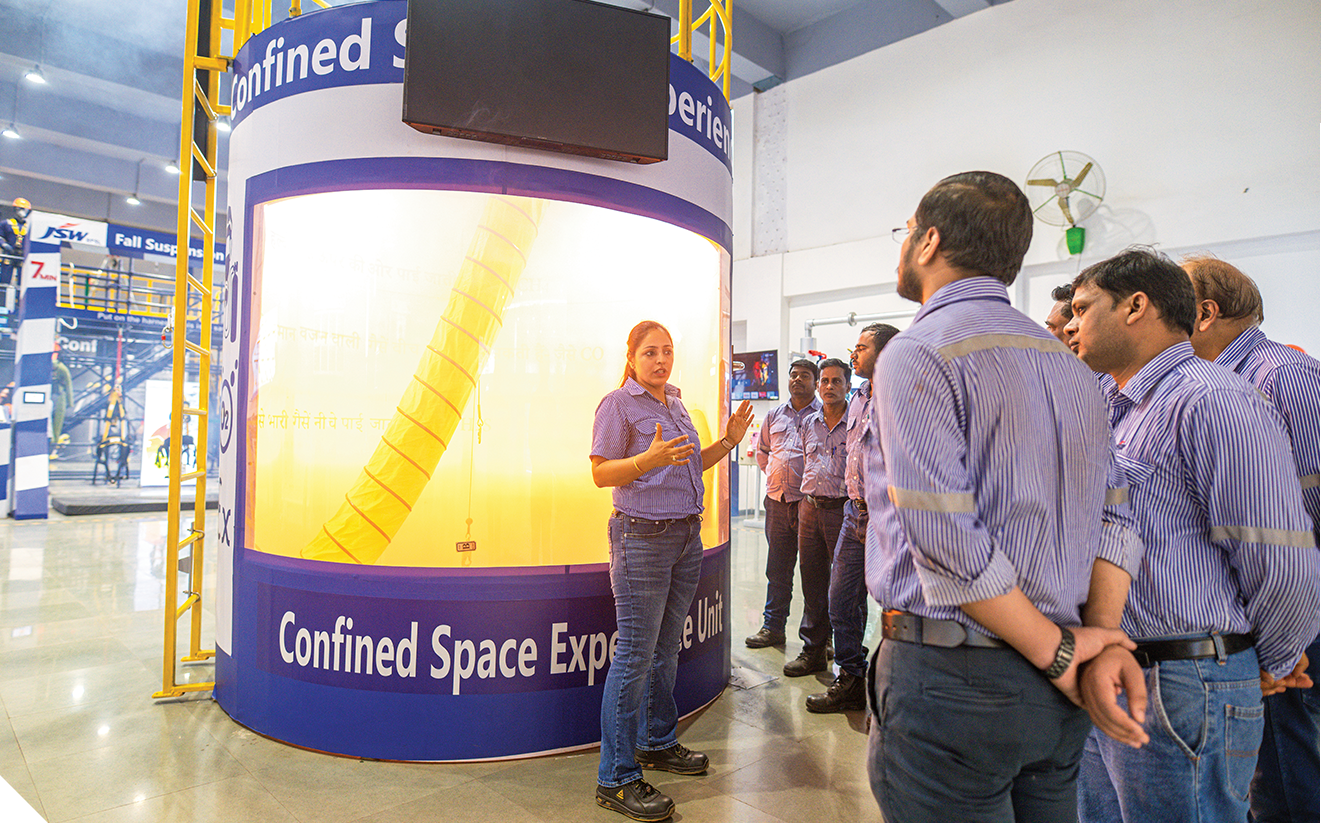
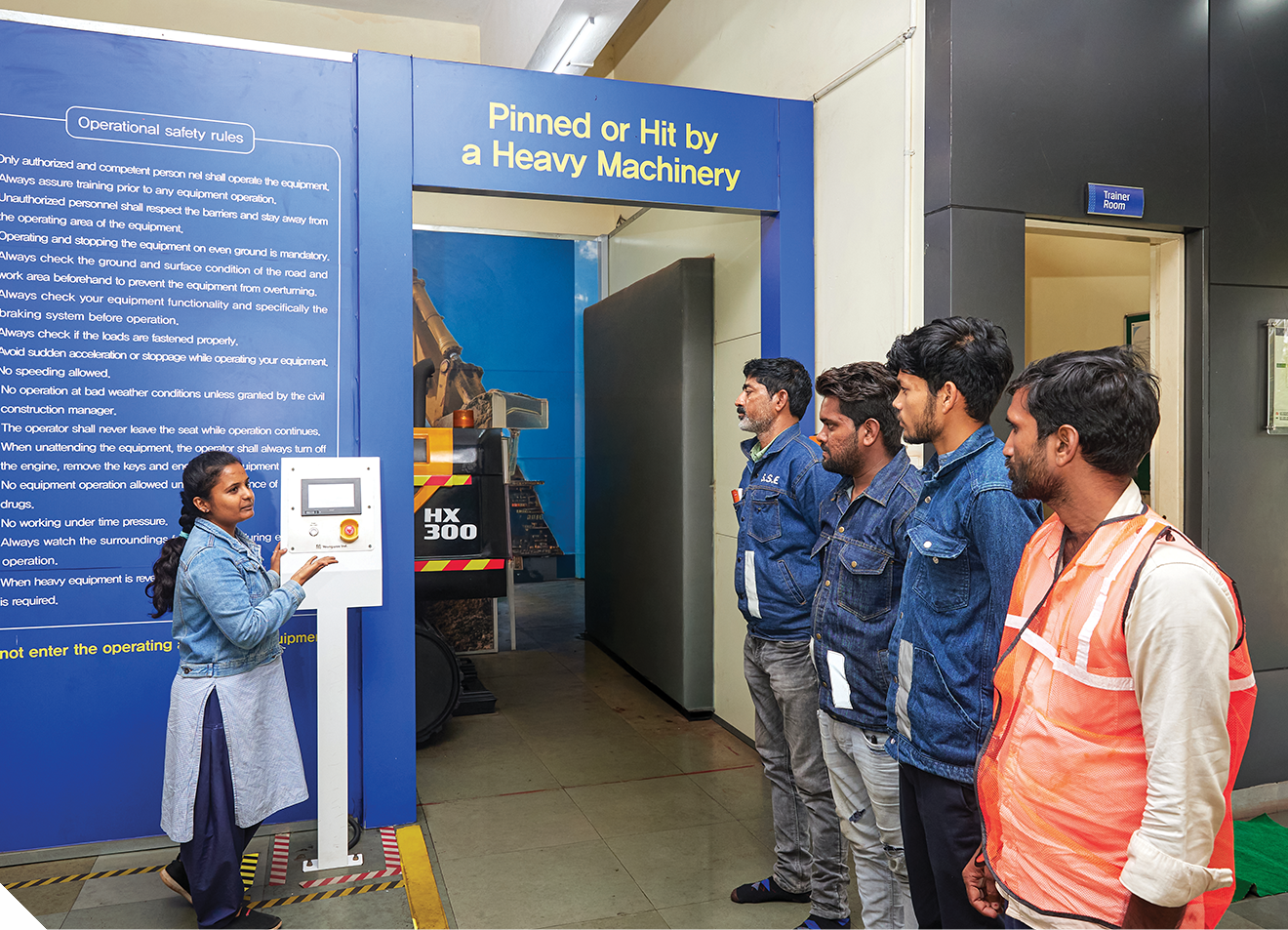
These centres offer immersive, scenariobased training environments that recreate
actual workplace hazards, including
confined space emergencies, working
at height scenarios, electrical safety
simulations, and struck-by hazards in a
safe, controlled setting. By experiencing
hazards in a realistic environment before
encountering them on the job, workers
develop sharper hazard recognition
skills, stronger muscle memory for safe behaviours and a more profound
appreciation of the consequences of
unsafe actions. A new Safety Experience
Centre is under development at Salem to
further expand this capability.
Digital Visual Platform (DVP)
We have deployed the Digital Visual
Platform (DVP) across our operations
in FY 2025–26, enabling real-time
applications for PPE violation detection,
unauthorised parking, crowd detection
and other safety compliance monitoring
with AI-generated real-time alerts and
automated reports. This technologyenabled approach to safety monitoring
provides management with continuous,
objective feedback on compliance levels
across large, complex operational areas.
Continuous cultural engagement
Building and sustaining a safety culture
requires constant, consistent engagement
across the workforce, not just during
formal training events or safety week
celebrations. We maintain year-round
workforce engagement through monthly
safety campaigns, toolbox talks, incident
review sessions, safety skits and peer-topeer safety conversations.
Continuous engagement has deepened
the personal connection of every member
of the workforce to safety culture,
reinforcing the principle that safety is
not a departmental responsibility but
a shared commitment at every level of
our Company.

Digitalisation
and innovation
Technology is a powerful force multiplier
for safety management, enabling faster
decision-making, broader reach, deeper
analytics and more consistent compliance
monitoring than is possible through
manual processes alone. We have made
digitalisation and innovation a defining
pillar of our safety strategy, deploying a
suite of cutting-edge tools and platforms
that are transforming how safety is
managed, monitored and learned across
our operations.
Abhigyan – industry-first
conversational ai safety tool
In FY 2025–26, we achieved a landmark
in industrial safety technology with the
launch of ‘Abhigyan’ at Dolvi Steel, an
industry-first conversational AI tool that
provides employees and contract workers
with real-time, multilingual access to our
integrated safety standards. Abhigyan
leverages advanced natural language
processing to allow workers to query
safety procedures, permit requirements,
emergency protocols and regulatory
standards in their preferred language,
through a conversational interface that
requires no technical expertise to use.
This innovation addresses one of the most
persistent challenges in industrial safety,
ensuring that all workers, including those
with limited literacy or digital skills, have
immediate access to the information they
need to perform their work safely. Abhigyan
democratises safety knowledge and
eliminates language and literacy barriers
as obstacles to safe behaviour.
Electronic Permit to Work (E-PTW)
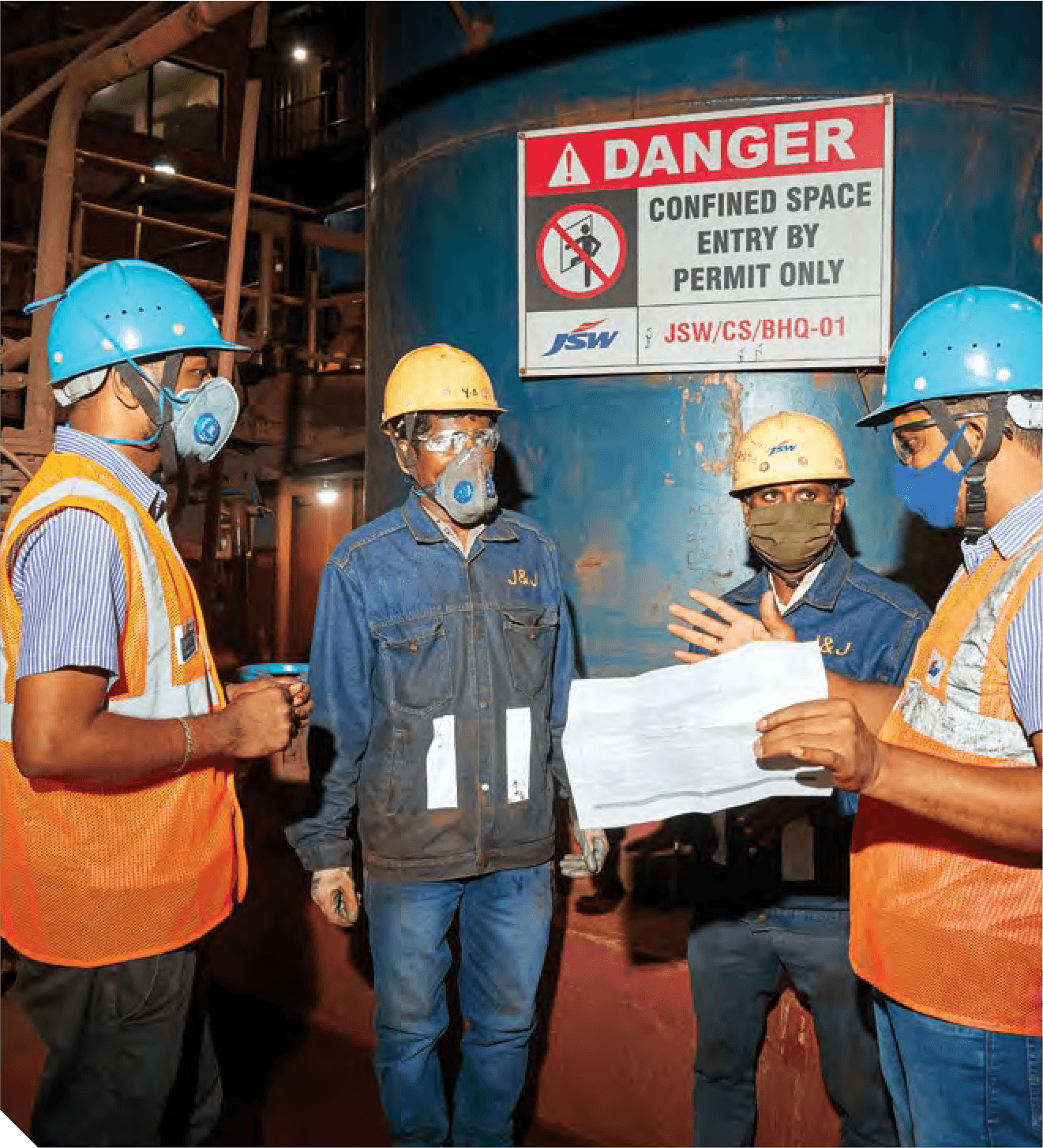
The Permit to Work (PTW) system is one
of the most critical controls for managing
high-risk work activities such as confined
space entry, hot work, work at height
and electrical isolation. Historically,
paper-based PTW systems have been
prone to errors, delays, inconsistency
and loss of documentation, creating
significant compliance risks.
In FY 2025-26, we implemented Electronic
Permit to Work (E-PTW) systems across key sites, digitising the entire permit
lifecycle from application and approval to
issuance, extension and closure. E-PTW
ensures that all permits are complete,
consistent and traceable; that approvals
involve the right personnel; and that
real-time data on active high-risk work
is available to safety managers at all
times. The system also enables trend
analysis on permit compliance, providing
early warning of deteriorating standards
before incidents occur.
Digital Visual Platform (DVP) – AIpowered compliance monitoring
We deployed the Digital Visual Platform
(DVP) across our operations in FY 2025-26,
using artificial intelligence and computer
vision to provide real-time monitoring of
safety compliance across operational
areas. DVP applications include automated
detection of PPE non-compliance (helmets,
vests, gloves, footwear), unauthorised
access to restricted areas, unsafe
parking and crowd density monitoring
in high-risk zones.
The platform generates real-time alerts
to supervisors, enabling immediate
intervention before unsafe conditions
escalate into incidents. Automated reports
provide management with objective,
site-wide data on compliance trends,
enabling targeted interventions and
resource allocation. By removing the
dependence on manual observation for
compliance monitoring, DVP significantly
extends the reach and consistency
of safety oversight across large,
complex facilities.
Virtual Reality (VR) training
modules
Virtual Reality (VR) technology enables
immersive, experiential safety training
that is fundamentally more engaging and
effective than conventional classroom
instruction. In FY 2025–26, we deployed
VR-based training modules covering critical
hazard scenarios including Conveyor
Safety, Lancing Safety and a range of
other high-risk activities with over 11,000
contractor workers trained through 22
Virtual Reality modules during the year.
VR training places workers in a
photorealistic simulation of their actual
work environment, exposing them to hazard scenarios and emergency situations
that would be too dangerous to recreate in
reality. Research consistently demonstrates
that VR training produces superior
knowledge retention, hazard recognition
and decision-making under pressure
compared to traditional training methods.
By integrating VR into its safety training
architecture, we are delivering training that
not only educates but truly prepares our
workforce for the hazards they face.
Sustainability-linked
remuneration
At JSW Steel, Environment, Social and
Governance (ESG) criteria are embedded
in leadership performance evaluations
and serve as a critical pillar of executive
accountability. ESG forms a mandatory
Key Result Area (KRA) for the assessment
of our top leadership, including Executive
Directors, where it carries a significant
weightage of 15% to 20% in their individual
KRAs linked to the annual variable payout.
This direct alignment between ESG
outcomes and executive remuneration
reflects our Company’s commitment to
responsible value creation and highlights
the strategic importance placed on safety,
sustainability, equity and governance.
The evaluation of senior leadership includes
structured targets across key ESG themes.
These outcomes influence compensation
decisions and reinforce leadership
responsibility for advancing our Company’s
sustainability agenda.
Translating ESG themes into
measurable performance
outcomes
Climate Change
Key KRAs included expediting renewable
energy projects of ~1 GW; developing policy
to anchor the transition to renewables on
the principles of ‘Just Transition’ to create
alternative opportunities for those affected
by transition (e.g., workers, parts of our
supply chain, communities and customers/
consumers) ensuring inclusive progress
for employees, communities and partners;
driving operational efficiencies through
Centres of Excellence to meet defined CO2
emission reduction targets and formulating
strategies to minimise the impact of the
Carbon Border Adjustment Mechanism (CBAM). Leaders were also accountable for
establishing compliance systems aligned
with EU product carbon footprint standards.
Nature action
KRAs included targets related to water
stewardship, including reduction of specific
water consumption levels.
Equity Action
Executive evaluation included the
completion of Human Rights Due
Diligence (HRDD) across all integrated
steel operations, based on the United
Nations Guiding Principles on Business and
Human Rights.
Safety
Safety remains a non-negotiable
performance parameter. Leadership
compensation is directly impacted by
safety outcomes, with incidents and
fatalities serving as negative multipliers
in the variable pay structure. Senior
executives were accountable for elevating
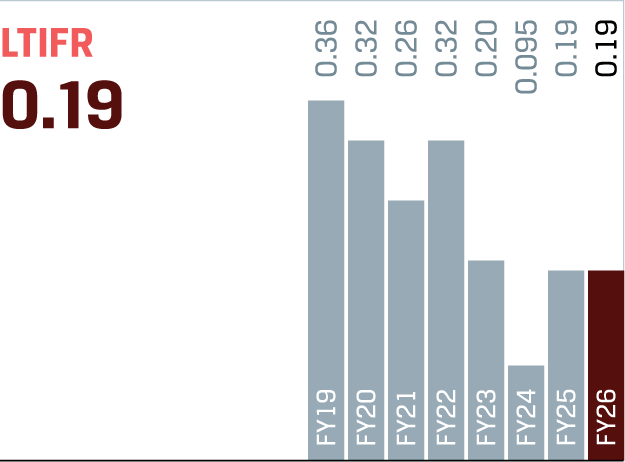
safety culture, improving performance
indicators (LTIFR) and contributing to
the collective goal of achieving a Zero
Harm workplace.
Community Well-being
Improve community reach by touching over
two million lives across initiatives across
education, health & nutrition and skill
development for livelihood improvement
through JSW Foundation.
In addition, leadership performance
assessments included responsibilities
related to proactive collaboration with
investors, regulators, government entities
and civil society organisations, aimed
at shaping responsible policies and
maintaining high standards of transparency
and accountability. Our leadership was
also expected to work on initiatives to
obtain and maintain ResponsibleSteel™
certification at key sites, positioning our
Company as a global sustainability leader.
These ESG-linked measures have been
instrumental in driving accountability at the
top and aligning executive incentives with
creating sustainable long-term stakeholder
value. By embedding ESG into how
leadership performance is assessed and
rewarded, we reinforce our commitment to
responsible, inclusive and ethical growth.
EMPLOYEE
WELL-BEING
AND BENEFITS
Our well-being ecosystem
strengthened through wider adoption
of JSW We Care and continued
recognition as a Great Place to Work.
Capitals interlinkages
UNSDGs
Employee well-being is viewed as a cornerstone of sustainable growth
and organisational excellence at our Company. Through comprehensive
health, financial, developmental and wellness initiatives, we continue
to foster a supportive and inclusive workplace that prioritises holistic
employee care, recognises individual contributions and strengthens
engagement, security and quality of life for employees and their families
across every stage of their journey.
Comprehensive employee care
Health insurance top-up
Strengthening employee well-being
through an enhanced Group Health
Insurance Top-Up Policy that provides
additional medical coverage for employees
and their families beyond the standard
Group Mediclaim Policy.
Employee Stock Option Plans
(ESOPs)
Encouraging long-term value creation
and employee ownership through the
ESOPs programme. During FY 2025-26,
over 1.88 million shares of JSW Steel
were granted to employees across
senior leadership, management and
high-performing talent segments. The
scheme is supported through share
acquisitions from stock exchanges.
Other benefits
Supporting employees across different life
stages through a range of non-monetary
benefits, including maternity and paternity
support, childcare facilities, postretirement benefits and partial crèche
reimbursement facilities.
Personal accident insurance
Providing financial protection through
Group Personal Accident Insurance
coverage for all employees, trainees
and probationers.
Term life insurance
Ensuring financial security for employees’
families through Group Term Life Insurance
coverage applicable to employees,
trainees and probationers in the event of
natural death or accidents.
Electric vehicle incentive
Advancing sustainable mobility by
encouraging the adoption of electric
vehicles through financial assistance
of up to ₹3 lakh (₹5,000 per month for
up to 60 months) under our Company’s
Car Lease Policy for eligible electric
vehicle purchases.
Awards and recognition
Recognising employee contributions
through structured programmes
celebrating performance, continuous
learning, innovation and long-term service.
Facilities and amenities
Enhancing employee well-being through
access to townships, fitness centres
and other lifestyle amenities at select
locations, fostering a balanced and
healthy work environment.
JSW We Care
At JSW Steel, employee well-being extends
beyond the workplace, a reflection of
our supportive, inclusive and peoplecentric culture. Through JSW We Care,
employees and their families are provided
access to a dedicated and confidential
counselling platform that supports
mental health, emotional well-being and
holistic development. Available round the
clock, the initiative offers professional
guidance across personal, emotional and
work-related dimensions while awareness
sessions help employees understand
the programme, its services and the
assurance of complete confidentiality.
The Employee Assistance Programme
(EAP) under JSW We Care witnessed
encouraging engagement during
FY 2025-26, reflecting increasing
awareness and acceptance of mental
wellness support across our Company.
During the year, over 3,729 new
employees registered for the programme,
while more than 430 counselling sessions
were conducted. The programme also
extended support to employees’ families,
with 48 family members registering and 25
actively availing counselling assistance.
In addition, five maternity cases were
successfully onboarded during the year.
3,700+
New employee registrations
430+
Counselling sessions conducted
24x7
Confidential counselling assistance
Ethics 24*7 helpline
We introduced the Ethics 24*7 Helpline
as a confidential platform for reporting
misconduct and ethical concerns.
Managed by the independent third-party
provider Integrity Matters, the service
is accessible in multiple languages,
including English, Hindi, Tamil, Telugu,
Marathi, Kannada and Bengali, enabling
wider accessibility and greater inclusivity
across the workforce.
Grievance redressal
Our digital human resources support
helpdesk facilitates timely resolution
of employee queries relating to
compensation, benefits, payroll, transfers,
reimbursements and performance
management. Managed through the Global
Business Solutions (GBS) Shared Services
Centre, the platform is complemented
by digital helpdesks across locations to
ensure seamless employee support.
Employee-managed
committees
To maintain high standards across
transport and canteen services,
employee-led committees actively
oversee service quality, hygiene and
operational effectiveness. These
committees help foster a safe, comfortable
and employee-friendly workplace
environment across locations.
We continue to earn recognition as a
workplace where people are empowered
to grow, contribute and thrive. During the
year, JSW Steel was certified as a Great
Place to Work, reaffirming the strength of
our people-first culture and our sustained
focus on building a high-trust, inclusive
and engaging work environment. This
recognition reflects our commitment
to employee well-being, transparent
communication, continuous learning and
meaningful career development across
our organisation.
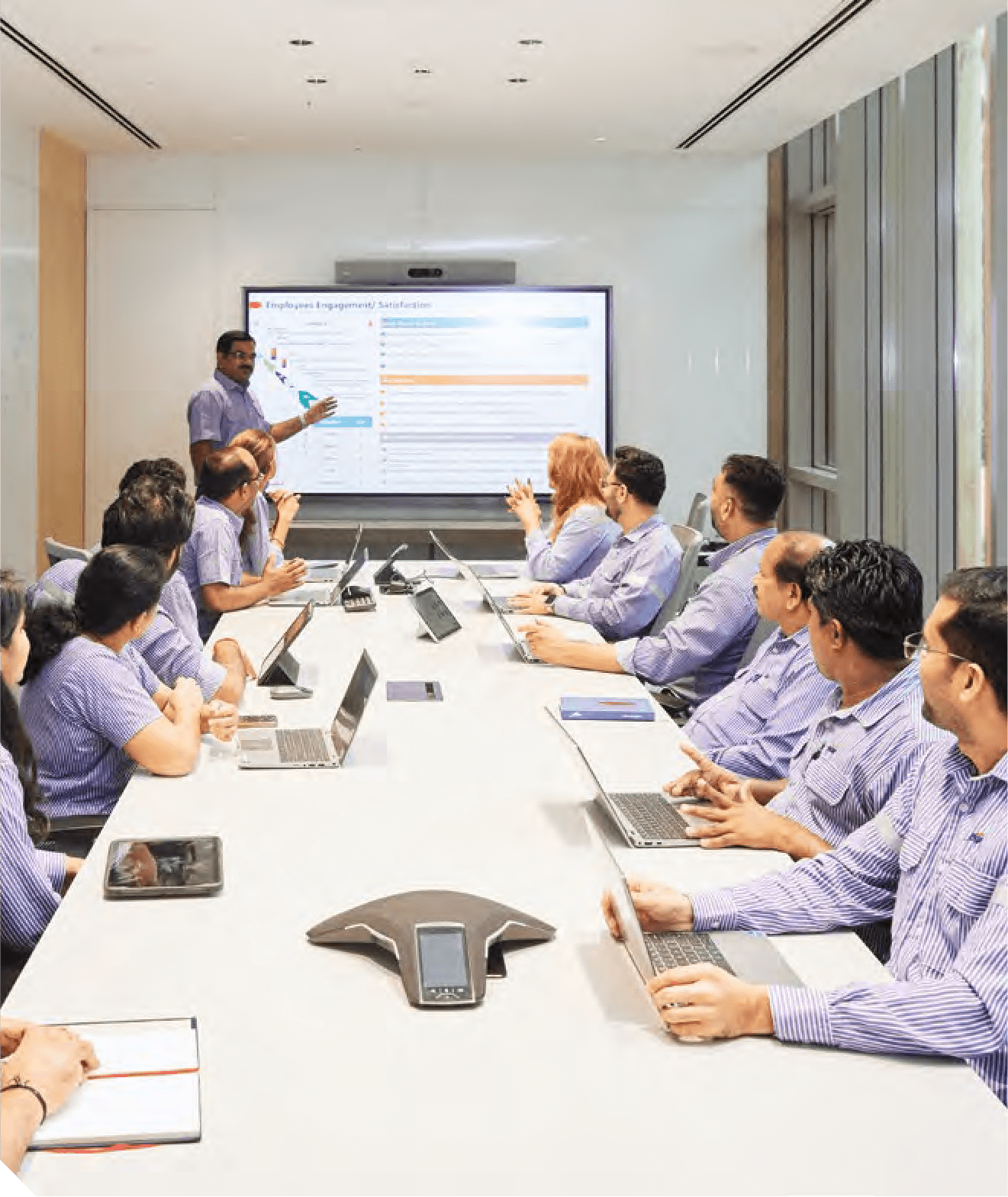
Employee feedback remains central to our
improvement journey, helping us identify
opportunities to strengthen engagement,
inclusion and the overall workplace
experience. We remain committed to
nurturing a rewarding culture where every
employee feels valued, supported and
inspired to contribute meaningfully to
JSW Steel’s growth.
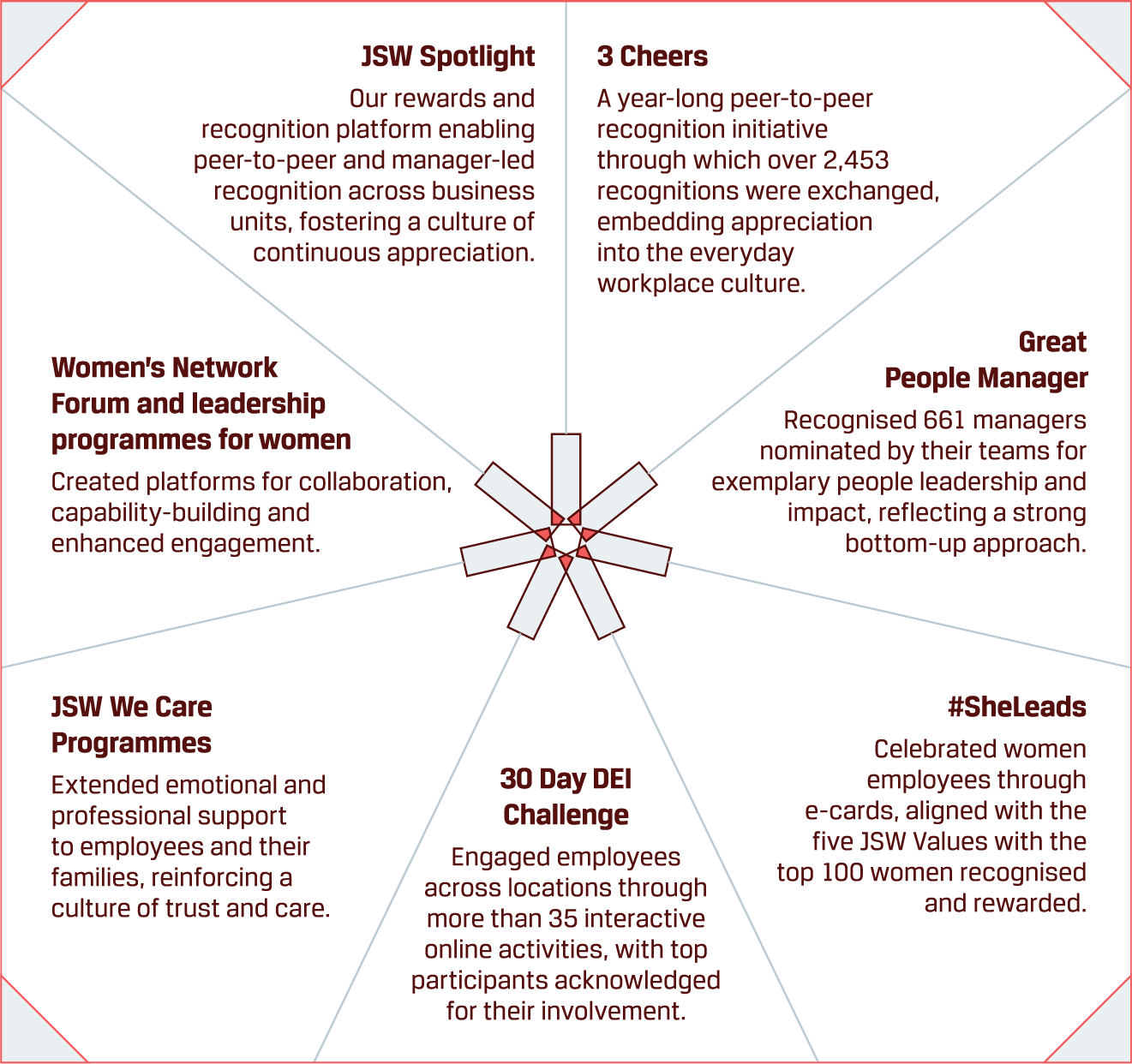
Celebrating our people
The year witnessed stronger employee
engagement driven by recognition, peer
appreciation and inclusion-led initiatives.
JSW Spotlight, the flagship rewards
and recognition platform, continued to
celebrate employee achievements through
both peer-to-peer and manager-led
recognition while ensuring engagement
via awareness sessions, contests and awards across business units. The yearlong 3 Cheers
programme recorded over
2,453 peer recognitions, while the Great
People Manager (GPM) initiative honoured
661 managers nominated by their teams
for exemplary people leadership. The
organisation’s commitment to inclusion
was further reinforced through initiatives
such as the #SheLeads campaign (March
2026), the 30-Day DEI Challenge and
Women’s Success Story showcases.
Recognition and inclusion
The year witnessed stronger employee engagement through initiatives focused on
recognition, inclusion, development and well-being. Programmes centred on appreciation,
leadership acknowledgement, diversity and employee support helped strengthen
employees’ connection with our Company while fostering a more inclusive and
collaborative workplace culture. DEI initiatives, leadership development platforms and
sensitisation workshops further reinforced a sense of belonging across the workforce,
while well-being programmes provided employees and their families with emotional and
professional support. Dedicated forums and leadership platforms for women also created
opportunities for growth, collaboration and deeper organisational engagement.
Key initiatives in FY 2025-26
Embedding employee feedback
Employee feedback continued to play a central role in shaping learning, development
and people practices across our Company. Insights were gathered through structured
channels such as the My Learning Survey which informed the blended learning approach for
FY 2025-26 and nomination-led initiatives including the Great People Manager programme,
where employees across our Company nominated their managers through a bottom-up
process grounded in real workplace experiences. Structured Individual Development Plan
(IDP) discussions further strengthened this feedback ecosystem by enabling employees to
identify capability gaps and articulate their development aspirations.
These insights translated into tangible enhancements across the learning architecture and
recognition culture. Findings from the My Learning Survey directly influenced the blended
learning strategy for FY 2025-26 with a stronger focus on adaptability, digital and data-driven
decision-making, inclusive leadership, critical thinking and a growth mindset. Digital learning
interventions were also integrated into the appraisal cycle to support employees in achieving
performance goals through targeted upskilling. In parallel, the bottom-up nomination process
under the Great People Manager initiative helped reinforce clear benchmarks for excellence in
people leadership.
Addressing employee
grievances
Employee concerns and grievances
continued to be addressed through a
structured, transparent and employeecentric framework designed to foster
fairness, trust and psychological safety
across our Company. Multiple formal
mechanisms enabled employees to
raise concerns, seek support and
access timely resolution in a safe and
confidential manner.
A key pillar of this framework is the
Ethics 24×7 Helpline, a confidential,
third-party managed platform that enables
employees to report misconduct safely
and anonymously in multiple languages,
ensuring accessibility, impartiality and
protection while addressing sensitive
concerns. Complementing this, the digital
human resources support helpdesk,
managed by the Global Business
Solutions (GBS) Shared Services Centre
along with location-based helpdesks,
facilitated the efficient and transparent
resolution of day-to-day employee
queries related to compensation, payroll,
benefits, transfers, reimbursements and
performance management.
We also continued to reinforce employee
well-being, dignity and fairness through
dedicated support and sensitisation
initiatives. JSW We Care/EAP provided
employees with a secure and confidential
platform to seek professional guidance
for personal, emotional or work-related
concerns. POSH (Sammaan) training
programmes and ongoing communication
campaigns further strengthened
awareness around maintaining a
respectful, inclusive and safe workplace
culture. Fairness also remained embedded
within our performance management
processes, supporting equitable
opportunities for employee growth and
development across our Company.
Talent management
strategy
Our Company’s talent strategy continued
to strengthen visibility across the
talent pipeline by identifying individual
strengths, potential and development
needs. By aligning leadership capabilities
with succession planning, our
Company ensured that critical roles
were supported by the right talent
while advancing personal growth
and organisational success through
focused career development and
capability-building initiatives.
Investing in future-ready
leadership
FY 2025–26 marked a year of sustained
and strategic investment in strengthening
our leadership pipeline. We continued
to reinforce our commitment to
identifying, developing and retaining
talent across all levels, from early-career
professionals to senior leaders through
a range of structured, institution-led
development programmes.
During the year, our talent management
strategy sharpened its focus on three
interconnected priorities: enhancing
visibility across the talent pipeline, aligning
leadership capabilities with succession
requirements and creating targeted
development journeys that supported both individual growth and organisational
readiness. A key milestone was the
expansion of the Annual Talent Review
process to include middle management,
supported by the establishment of
Plant Talent Councils across the Steel
business, covering more than 800 middle
management employees. This reflected
a conscious effort to deepen the talent
agenda across the organisation beyond
senior leadership levels.
The year also witnessed strong
participation across flagship leadership
initiatives. Twelve senior leaders
completed the Senior Leadership
Development Programme in collaboration
with Brown University, while 37
participants graduated from the Young
Leaders Programme conducted in
partnership with Indian Institute of
Management Lucknow. Under the
Springboard initiative, 30 high-performing
women completed the Women
Leadership Journey with Indian Institute
of Management Bangalore. In addition,
111 participants progressed through the
Technical Leaders Programme, and 12
senior leaders completed the Executive
Coaching Programme. The year further
saw the formalisation of the FFL Alumni
Network as a post-programme support
platform, ensuring continued development
and collaboration beyond the initial
six-month learning journey.
1
Future Fit Leaders (FFL) programme
The Future Fit Leaders (FFL) programme, now in its ninth year, continued to
remain
the cornerstone of JSW Steel’s leadership development architecture in FY
2025-26.
The programme’s talent identification framework is anchored in JSW’s Potential
Indicators,
based on the 3A construct - Agility, Ability and Aspiration, providing a
comprehensive lens
to assess cognitive capability, leadership potential and growth orientation.
Development journeys continued through partnerships with Cornell University for
Senior
Management FFLs and Indian School of Business for Middle and Junior Management
FFLs, combining classroom and virtual learning with Individual Development Plans
(IDPs) and Action Learning Projects. During the year, the programme further
evolved
with the formalisation of the FFL Alumni Network, creating a sustained
post-programme
engagement structure through initiatives such as the Talent Review Board, Coffee
Connects with senior leaders, Career Conversations led by Group Talent and
Business
Talent teams, personalised coaching through Skillsoft’s global coaching network
and
masterclasses on emerging industry trends. The six-month FFL journey also
continued
to strengthen strategic thinking and leadership readiness, while the Know Your
Talent
initiative enabled one-on-one interactions between Senior FFLs and JSW leaders
to align
career aspirations with future organisational opportunities.
2
Young Leaders Programme
The Young Leaders Programme, conducted in partnership with Indian Institute of
Management Lucknow, further strengthened its role as a focused development
platform for high-potential early-career professionals. Designed in a mini-MBA
format,
the programme aims to prepare future leaders through a blend of managerial,
strategic
and leadership learning. In FY 2025–26, 37 participants successfully completed
the
programme, reinforcing the organisation’s continued investment in nurturing
emerging
leadership talent.
3
The Springboard programme
The Springboard programme, the Women Leadership Journey delivered in
collaboration
with Indian Institute of Management, Bangalore entered its fifth batch during
the
year, reflecting five consecutive years of focused investment in women’s
leadership
development. Built around Development Centre assessments, the JSW Potential
Framework
and Personality Trends for Women Leaders, the curriculum covered self-awareness,
career development, personal branding, macroeconomics, industry evaluation and
digital
transformation. The programme combined foundational and strategic learning
disciplines
to strengthen leadership readiness among women professionals, with 30
high-performing
women successfully completing the journey in FY 2025–26.
4
The Technical Leaders Programme
The Technical Leaders Programme, introduced in 2022 to address evolving
technofunctional requirements across the industry, continued to expand its reach
and impact
during the year. The programme is designed to strengthen specialised technical
and
leadership capabilities while preparing participants for larger operational and
strategic
responsibilities. In FY 2025–26, 111 participants were selected and actively
progressed
through the programme, reflecting the organisation’s commitment to building
future-ready
technical leadership talent.
5
The Senior Leadership Development Programme (SLDP)
The Senior Leadership Development Programme (SLDP), delivered through the Brown
University Programme Framework, continued to strengthen readiness for larger
leadership
responsibilities among senior executives. The programme focused on enhancing
leaders’
understanding of external business dynamics, including social, political,
economic,
digital and environmental trends, alongside industry-specific challenges,
innovation and
operational excellence. Each participant was supported through Individual
Development
Plans aligned with future role transitions, one-on-one executive coaching and
360-degree
feedback mechanisms designed to track development progress and leadership
effectiveness. Twelve senior leaders completed the programme during FY 2025–26.
6
The Executive Coaching Programme
The Executive Coaching Programme, conducted in partnership with the Coaching
Foundation of India, continued to support leaders transitioning into larger
responsibilities
and those within the succession pipeline. Through customised Individual
Development
Plans and personalised coaching interventions, the programme aimed to strengthen
leadership effectiveness, transition readiness and self-awareness around
individual
strengths, motivations and developmental areas. In FY 2025–26, 12 senior leaders
completed the programme as part of the organisation’s broader leadership
readiness framework.
7
The Annual Talent Review Process
The Annual Talent Review Process further reinforced leadership readiness at the
middle
management level by providing employees from L13 to L18 with a structured
platform
to articulate career aspirations, receive calibrated feedback and access focused
developmental interventions. The process assessed leadership potential through
manager
feedback, 360-degree evaluations and structured calibration by the Central
Talent
Council and Plant Talent Councils, strengthening transparency and alignment
within the
organisation’s succession and talent development framework.

Participant feedback
strengthening leadership
development
Participant feedback continued to play
a pivotal role in shaping leadership
development programmes at our
Company, with FY 2025–26 reflecting
the translation of these insights into
meaningful structural enhancements.
One of the most significant outcomes
during the year was the strengthening of
post-programme engagement for Future
Fit Leaders (FFL) graduates. To better
understand participant expectations,
the organisation conducted a survey
involving 123 FFL alumni across business
verticals, complemented by 21 one-onone interviews and external benchmarking
against leadership development
programmes at comparable organisations.
These insights directly informed the
formalisation of the FFL Alumni Network
as a sustained engagement platform
designed to support continued leadership
growth beyond the core programme
journey. The network now enables
ongoing development through initiatives
such as Coffee Connects with senior
leaders, Career Conversations facilitated
by the Group Talent and Business Talent
teams, personalised coaching through Skillsoft’s international coaching network,
and regular masterclasses focused on
emerging industry trends.
Cross functional growth and
internal mobility
Internal mobility and cross-functional
development continued to remain integral
to the design of JSW Steel’s leadership
and talent programmes rather than being
treated as standalone interventions.
Career movement and job rotation formed
formal components of both the Future
Fit Leaders (FFL) and Senior Leadership
Development Programme (SLDP) journeys,
integrated alongside institutional learning
programmes and Individual Development
Plans (IDPs) across employee bands to
support broader organisational exposure
and leadership readiness.
The IDP framework followed a structured
development approach, beginning with
alignment discussions between managers,
participants and coaches to connect
career aspirations with developmental
priorities. This was complemented by
one-on-one coaching conversations
and continuous tracking of development
actions, ensuring that career progression
and readiness for larger roles were actively
planned, supported and monitored.
Feedback from FFL alumni further
highlighted strong demand for crossfunctional exposure, with cross-plant
visits, rotational opportunities, stretch
assignments and career advancement
emerging as key expectations across
locations. In response, the FY 2025–26
engagement framework for the FFL Alumni
Network was strengthened to support
sustained career mobility through Coffee
Connects with senior leaders, regular
career conversations facilitated by the
Group Talent and Business Talent teams,
and Talent Review Board discussions
focused on identifying new opportunities
across the JSW Group.
Group-wide talent visibility through the
Central Talent Council and Plant Talent
Councils also continued to strengthen
the organisation’s internal leadership
pipeline by ensuring that high-potential
employees remained visible beyond their
immediate business units. The annual
talent review process further reinforced
this approach by supporting succession
planning and preparing internal talent for
larger cross-functional responsibilities
as opportunities emerged across
the organisation.
Future-ready learning and
capability building
FY 2025–26 marked a significant step
forward in strengthening learning and
capability development across our
Company, with Learning & Development
positioned as a strategic enabler of future
readiness in alignment with Industry 5.0
priorities. Guided by insights from the My
Learning Survey, our organisation adopted
a blended learning approach designed to
strengthen both technical and behavioural
capabilities across all levels.
The learning strategy focused on building
adaptability, digital and data-driven
decision-making, inclusive leadership,
critical thinking and a growth mindset,
supported by structured learning
pathways and continuous feedback
mechanisms. By embedding learning into
day-to-day work and aligning capability
development with organisational
priorities, we are taking significant strides
towards building an agile, resilient and
future-ready workforce.
We ensure that our workforce remains
resilient and future-ready, capable of
adjusting to technological advances,
regulatory changes, and climate-driven
transformations. This approach reduces
the risk of disruption to both operations
and livelihoods, while fostering a culture
of continuous improvement and shared
responsibility for sustainable growth.
Leadership excellence and
Industry 5.0 readiness
The year witnessed several highimpact development initiatives aimed
at strengthening leadership excellence,
advancing inclusion and enhancing
functional capability across our Company.
The flagship AI Leadership Accelerator
equipped senior leaders to leverage
Generative and Agentic AI for strategic
advantage while promoting responsible
and ethical innovation.
The Springboard programme, JSW Steel’s
women leadership initiative, continued
to strengthen the internal pipeline of
women leaders through personalised
development plans, mentoring support
and action-learning projects. In parallel,
the Sales Leadership Development Journey
2.0, delivered in partnership with Indian
Institute of Management, Ahmedabad,
further enhanced customer-centricity,
business acumen and change leadership
capabilities. Focused capability-building
programmes across sales, commercial
and technical functions also continued
to deepen domain expertise aligned with
evolving business priorities.
Our learning and development initiatives
remained closely aligned with emerging
business priorities such as digitalisation,
automation and sustainability, reflecting
our commitment to the human-centric
principles of Industry 5.0. Programmes
such as the AI Leadership Accelerator
strengthened the strategic and
responsible adoption of advanced
technologies, enabling leaders to drive AIled transformation across the organisation.
Data analytics and visualisation
interventions further enhanced digital
fluency at scale, supporting smarter, more
efficient and sustainable decision-making.
Leadership programmes also emphasised
ethical technology adoption, inclusion
and organisational agility, ensuring
that automation complemented human
capability rather than replacing it.
Collectively, these initiatives strengthened
a workforce capable of driving
technological innovation while advancing
long-term environmental, social and
business sustainability objectives.
Learning reimagined
digitally
Digital platforms have reshaped learning
at our Company by ensuring an agile, ondemand and personalised development
ecosystem. Through platforms such
as JSW Coursera, HBR Spark, Skillsoft,
the JSW Steel Technical Academy and
integrated digital learning pathways,
employees can access global content,
immersive labs and certifications in
AI, analytics and domain expertise
- anytime, anywhere. These digital
learning journeys encourage self-paced
development while enabling assessments,
application-led assignments and datadriven insights to drive continuous
improvement. The transition from
episodic training to continuous capability
building is accelerating rapid upskilling
and reinforcing our Industry 5.0 vision
of a human-centric, technologyenabled workforce.

Strengthening capability through partnerships
External partnerships remain central to our capability-building strategy, providing access
to world-class learning, global best practices and specialised expertise. Collaborations
with Tier-1 institutes for leadership development journeys, alongside partnerships with
leading global content providers such as Harvard, Skillsoft, Coursera and steelUniversity,
ensure exposure to cutting-edge research, advanced skilling pathways and international
benchmarking standards. These collaborations enable employees to pursue globally
recognised certifications, engage with diverse industry perspectives and build capabilities
that foster innovation, operational excellence and competitiveness in an increasingly
dynamic business environment.
Driving performance through continuous learning
Learning initiatives at JSW Steel have significantly strengthened performance and career
progression across levels by embedding continuous capability building into the employee
lifecycle. The Technical Academy, integrated into the GET induction programme has
accelerated technical competency development and improved early-career performance,
while digital learning aligned with the appraisal cycle has enabled targeted upskilling
to support performance goals. Leadership development journeys culminate in Action
Learning Projects that address real business challenges, often leading to enhanced
responsibilities and accelerated career growth. Structured Individual Development Plan
(IDP) discussions further support employees in identifying capability gaps and pursuing
focused development pathways.
The Technical Leaders Programme (TLP) and the JSW Steel Technical Academy together
form the cornerstone of the Company’s future-ready capability ecosystem. The TLP
develops high-potential technical talent into leaders who drive innovation, sustainability
and operational excellence, while the Technical Academy offers personalised, role-based
digital learning through globally benchmarked content.
Building trust through impact
Inspired by our Company’s
#BetterEveryday philosophy,
we aim to ensure that the
growth of our company unfolds
in concurrence with the
upliftment and well-being of
the people and communities
touched by our operations.
We recognise that our operations affect
a diverse group of stakeholders, including
employees, workers across our value
chain, local communities, and customers,
both directly and indirectly. These impacts,
be it positive or negative, shape our
relationships with these stakeholders,
and managing them in a proactive and
responsible manner is paramount for
maintaining our business' long-term
social license to operate, enhancing our
reputational capital, and strengthening
overall business resilience. Thus, this year,
we ramped up our efforts to identify and
address the impacts of our operations
on key stakeholder groups by launching
initiatives across a broad range of focus
areas, including education, skill-building,
livelihoods, human rights, agriculture,
and social equity.
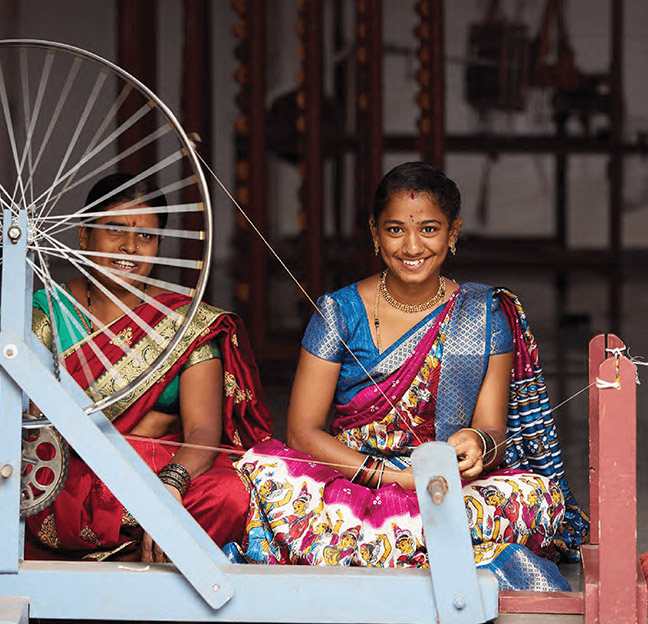
Objective
Uplift communities via social welfare initiatives.
Progress towards the objective
26 lakh
beneficiaries reached in FY 2025-26.
Risk addressed
- 1
- 2
- 3
- 4
- 5
- 6
- 7
- 8
- 9
- 10
- 11
- 12
- 13
Acknowledging the nexus between
social sustainability and value creation
While social sustainability is undeniably a critical fiduciary responsibility for our business,
we see it as much more than that. At JSW Steel, we view social sustainability as a powerful
yet often under-recognised lever for long-term value creation. While the role of such
initiatives in advancing the socio-economic upliftment of marginalised and underserved
communities by, among other things, alleviating hunger, improving literacy, and enhancing
health and sanitation is widely acknowledged, we believe their broader strategic business
value is often overlooked. Besides delivering meaningful outcomes for stakeholders,
social sustainability efforts can also beget a plethora of benefits for businesses, including
unlocking new markets, shoring up key stakeholder relationships, bolstering reputational
capital, improving employee engagement and retention, and catalysing innovation. In
coherence with this understanding, this year, we intensified our efforts endeavouring
to further ingrain social sustainability into the very core of our Company's value creation
strategy and purpose. This move reflects our belief that a company's success remains
deeply intertwined with the well-being of its communities and that a commitment to social
impact is essential for sustainable, long-term growth.
SAMMS approach
We recognise that translating our social sustainability vision into tangible action requires
adopting a structured approach that enables us to design and implement high-impact
interventions, monitor and evaluate their outcomes, and forge trust-based partnerships
with the communities we serve. Therefore, we adopt the Strategic, Aligned, MultiStakeholders,
Measurable, Sustainable (SAMMS) approach. This approach, which now
underpins the full portfolio of our social sustainability initiatives, ensures that our social
sustainability initiatives directly align with our broader organisational objectives, foster
community engagement, and deliver measurable results. The adoption of this robust
methodology has enabled us to deliver consistent and lasting impact in the communities
where we operate.
₹210 crore
CSR expenditure
Values driven by people
We view the protection of
human rights not merely as a
compliance requirement but as
a core expression of our values
and commitment to promoting
diversity, equity and inclusion
and uplifting the communities in
which we operate.
Objective
Balance the needs, interests, and
expectations of all stakeholders
with business priorities, while
safeguarding the welfare of
communities where we operate
and consistently upholding human
rights across the value chain.
Progress towards the objective
Achieved 100% Human Rights Due
Diligence (HRDD) coverage across
all ISPs and mines.
In line with our commitment to operationalising the triple bottom line framework, which
treats people, planet, and profit as equally vital measures of business success, we strive
to treat every individual connected to our operations, be it employees, business partners,
contract workers, or surrounding communities with dignity, respect, and fairness.
To translate this belief into meaningful action, we have built a robust human rights
governance structure anchored in four key pillars: building awareness across the value
chain, identifying and evaluating potential risks, designing targeted mitigation strategies,
and ensuring continuous oversight through regular progress reviews. This structured
approach enables us to move beyond intent and embed human rights considerations
into the fabric of our day-to-day decision-making across all operational levels.
Approach to human rights management
Our approach to human rights management is grounded in the conviction that respecting
and protecting human rights is an active, ongoing responsibility—not merely a passive
obligation satisfied by regulatory compliance alone. To instil this conviction at the heart
of our operational ethos, we have adopted a comprehensive Policy on Protecting Human
Rights, supported by an internal Technical Standard that provides operational guidance
on identifying material human rights issues, assigning accountability, and implementing
effective management systems and procedures across our operations.
Our human rights framework ensures full compliance with all applicable national and
international laws, regulations, and standards, including the Universal Declaration of
Human Rights, the core conventions of the International Labor Organization, and the United
Nations Declaration on the Rights of Indigenous Peoples. We also transparently disclose
our human rights performance through the Global Reporting Initiative (GRI) standards,
against the United Nations Sustainable Development Goals (UN SDGs), and under Principle
5 of the National Guidelines on Responsible Business Conduct (NGRBC) as part of our
Business Responsibility and Sustainability Report (BRSR).
Our commitment to human rights is further reinforced by three interrelated policies that
govern how we engage with our workforce, our communities, and our broader value chain:
the Policy on Labour Practices and Employment Rights, the Policy on Enhancing Equality,
Diversity and Inclusivity, and the Policy on Business Conduct. In tandem with our Policy
on Protecting Human Rights, these policies form a cohesive governance architecture that
embeds respect for human rights into the way we operate, make decisions, and conduct
business at every level of our organisation.
Human rights due diligence
As of FY 2025–26, we have achieved 100% HRDD coverage across all our Integrated Steel
Plants (ISPs) and mines. Through comprehensive HRDD risk assessments, we proactively
identify, assess, and address actual and potential human rights impacts across both our
operations and value chain, ensuring that every facility we operate upholds the highest
standards of ethical conduct, dignity, and fairness.
Beyond mitigating risks, our HRDD process serves a broader strategic purpose. It allows
us to cultivate deeper understanding of the communities in which we operate, strengthen
engagement with rights holders, and ensure that our presence creates lasting social
value. By systematically evaluating our human rights performance and translating
insights into targeted management actions, we move beyond compliance to uphold
human rights across operations, while contributing to community well-being and
sustainable development.
We extend our HRDD framework to all new business relationships, including mergers,
acquisitions, and joint ventures, integrating human rights considerations into investment
and business decisions from the earliest stages of engagement.
Human rights risk assessments, which form the cornerstone of our HRDD process,
follow the structured five-step methodology detailed below.
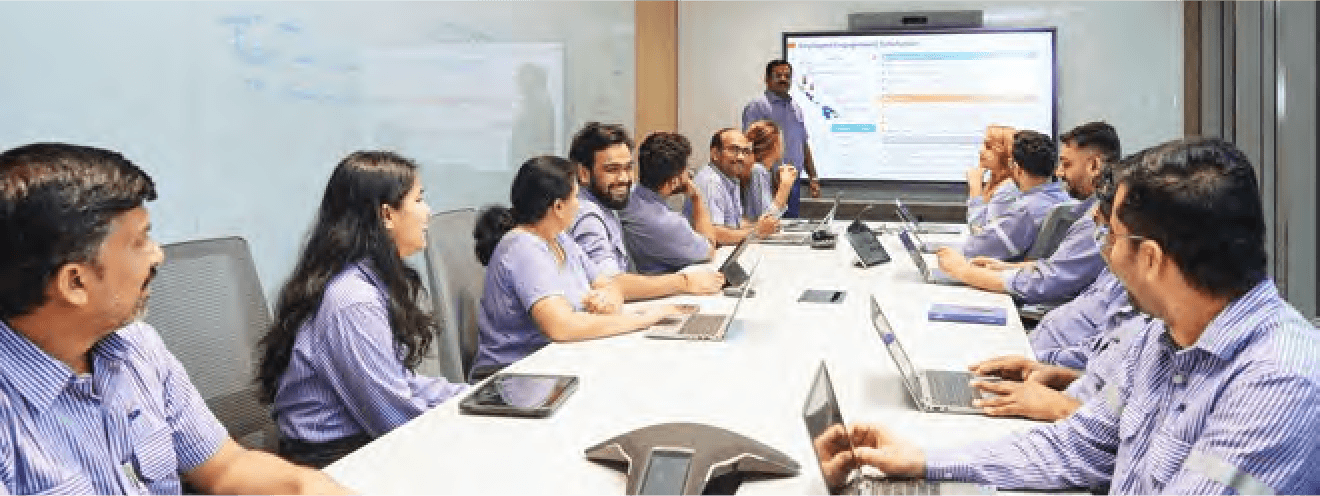
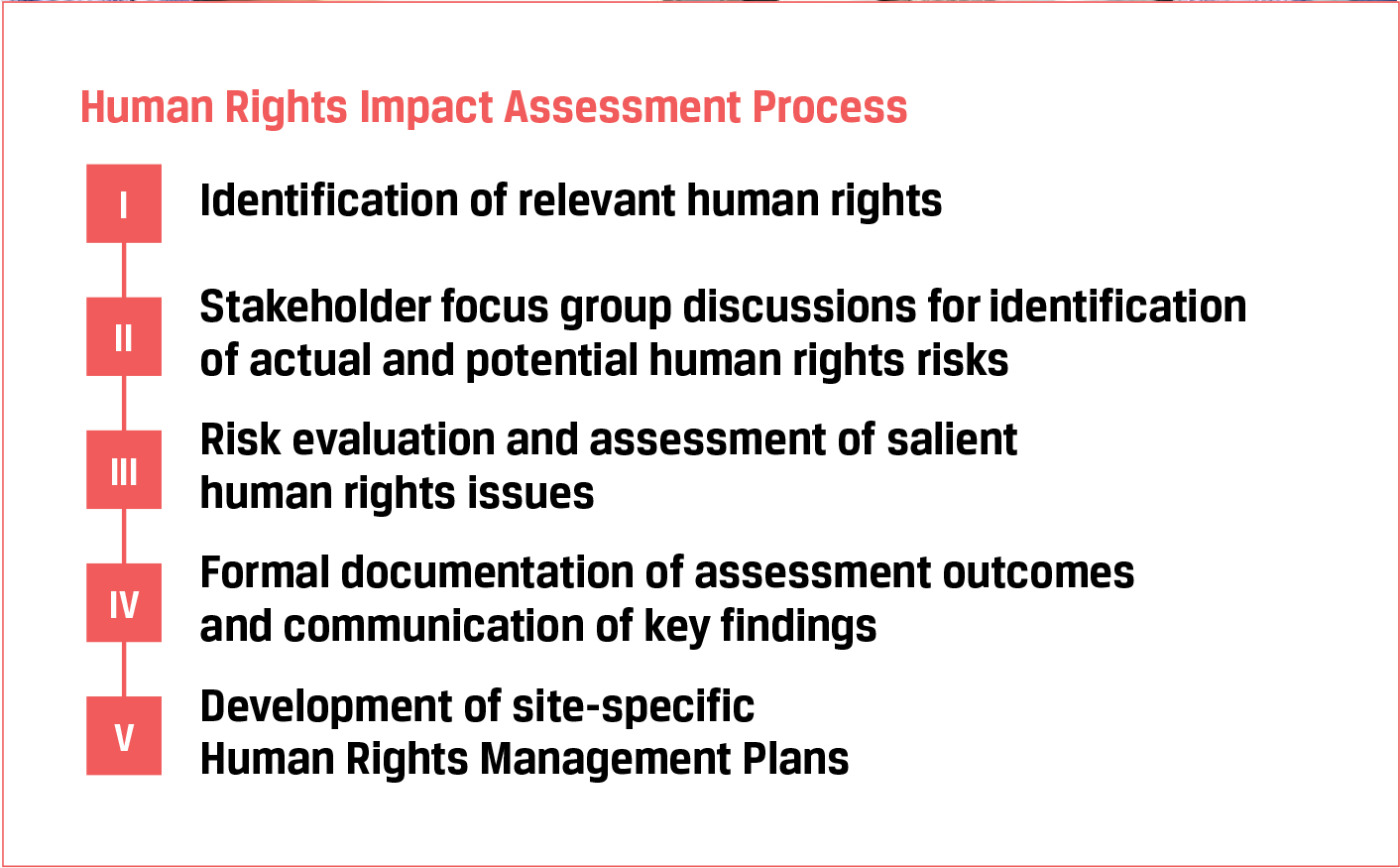
To ensure our approach remains relevant and responsive to evolving contexts, we
periodically review our human rights risk mapping and continuously reassess actual
and potential human rights impacts across our operations. The insights generated
through these assessments inform the development of targeted management plans, the
strengthening of governance mechanisms, the clear allocation of accountability, and the
establishment of measurable performance targets. Collectively, these actions enable us
to safeguard the rights of key stakeholders and embed human rights considerations into
decision-making processes across all levels of the organisation.
Identified rights holders
Our commitment to respecting and
upholding human rights extends to
all individuals who our operations and
activities may affect across the value
chain. Thus, our HRDD process covers
a broad range of key rights holders:
employees, contract workers (including
migrant workers), local communities and
societies (with particular attention to
women, children, and Indigenous Peoples),
suppliers, and customers.
Actions taken to advance human
rights across operations in
FY 2025-26
As of FY 2025–26, all our ISPs (Vijayanagar,
Dolvi, Salem, and Raigarh) and mining
operations across Karnataka and Odisha
have been assessed under our Human
Rights Due Diligence (HRDD) process,
achieving full coverage of our operational
and mining footprint. During the year,
we also initiated a Human Rights Risk
Assessment for JSW Utkal Steel Limited,
our under-construction greenfield ISP
at Paradeep, Odisha. This reflects our
commitment to embedding human rights
considerations into project planning from
the earliest stages of development and
consistently applying our HRDD framework
across our expanding portfolio.
We leverage the insights gained through
the HRDD process to formulate sitespecific human rights management
plans. These plans delve into the
intricacies of each site's unique
social context, meticulously outline
measures for risk mitigation, delineate
clear roles and responsibilities, assign
appropriate authorities, and set specific
targets to ensure the protection and
promotion of human rights within our
operational sphere.
This year, we also conducted targeted
human rights training and awareness
programmes for employees, business
partners, and security personnel across
our facilities. These initiatives sought to
strengthen understanding of human rights
principles, clarify roles and responsibilities,
and reinforce standards of conduct,
thereby fostering a culture of respect,
accountability, and responsible business
practices throughout our operations.
Our policy framework
A robust policy framework fully aligned
with the UN Declaration on the Rights of
Indigenous Peoples and IFC Performance
Standards guides our approach to
safeguarding Indigenous peoples'
rights. Central to this framework is our
commitment to Free, Prior and Informed
Consent (FPIC), which ensures that
Indigenous communities are engaged
early, informed transparently, and
empowered to participate meaningfully
in decisions that may affect them. Our
framework also emphasises culturally
sensitive benefit-sharing, the protection of
Indigenous heritage, and the safeguarding
of access to land and resources on which
these communities depend.
Engagement and impact
management
Before any project begins, we conduct
thorough baseline assessments
and participatory consultations with
Indigenous communities to ensure
that potential social and environmental
impacts are fully understood. Where
impacts are identified, mitigation plans are designed with a focus on livelihood
restoration and the preservation of access
to essential services, including healthcare,
education, and clean water. We also
integrate traditional ecological knowledge
into our biodiversity strategies and take
deliberate steps to avoid disruption to
culturally significant sites, reflecting our
deep respect for Indigenous heritage
and practice.
Community liaison and
accountability
Dedicated community liaison teams, which
include members chosen from Indigenous
communities themselves, ensure that
communication remains transparent,
accessible, and grounded in cultural
sensitivity. These teams also serve as
the first point of contact for grievance
redressal, providing communities with
a trusted and accessible channel to
raise concerns. Regular evaluations
of our Indigenous engagement efforts
reinforce accountability and enable us
to continuously improve the quality and
inclusivity of our approach.
SUPPLY CHAIN
SUSTAINABILITY
Impact across value chain
We consider fostering the
adoption of more sustainable
practices across our supply
chain as a powerful lever for
not only managing Scope 3
emissions more effectively but
also generating measurable
environmental and social
impact across the value chain.

In recent years, forging sustainable
supply chains has emerged as a strategic
imperative for businesses operating
in the manufacturing sector, where
horizontally integrated production systems
rely on complex global procurement
and distribution networks. Due to such
interdependencies, sustainability risks
and opportunities often spill over across
multiple businesses’ value chains, making
supply chain transformation paramount for
achieving enterprise-level ESG objectives.
In the global steel sector’s context, the
heterogeneity of inputs and geographically
dispersed supplier bases further
exacerbate this challenge by diminishing
transparency. At JSW Steel, however, we
believe this challenge presents an equally
compelling opportunity to stimulate
collaboration and collective action.
Objective
Assess the sustainability
performance of key supply chain
partners to ensure alignment
with JSW Steel's Supplier Code
of Conduct and facilitate their
adoption of more responsible
business practices.
Progress towards the objective
Conducted sustainability
assessments for 120 suppliers
and provided data-driven
roadmaps with targeted
recommendations to strengthen
their environmental, social, and
governance (ESG) performance.
Risk addressed
- 1
- 2
- 3
- 4
- 5
- 6
- 7
- 8
- 9
- 10
- 11
- 12
- 13
In pursuit of this vision, we published
a Supplier Code of Conduct (SCoC) in
2021. This document delineates a set
of minimum environmental, social, and
governance standards that suppliers
must satisfy to enter into, or continue
doing business with, our Company.
Regardless, we fully acknowledged
that inducing genuine change in supply
chain partners’ often deeply entrenched
operational practices necessitated
the implementation of a structured
instrument for operationalising the SCoC
through consistent assessment and
knowledge sharing.
Guided by this understanding, we
launched a Digital Supply Chain
Assessment Project in FY 2024-25.
This Project pursued three strategic aims:
- To assess and quantify the
sustainability performance of
major suppliers;
- To identify material areas for
improvement and foster the adoption
of more responsible practices; and
- To establish a mechanism for
systematically embedding
sustainability considerations into
procurement decision-making.
In FY 2025-26, the Project entered its
second phase. This year, it assessed and
quantified the sustainability performance
of 120 major suppliers through
self-assessments and synthesised the
findings gleaned from these evaluations
to formulate tailored, data-driven action
plans comprising recommendations
they can adopt to strengthen their
sustainability practices. In doing so, the
Project enhanced visibility into Scope 3
emissions, facilitated the identification
of high-risk suppliers with inferior
sustainability performance, and provided
them with the knowledge and capabilities
required to improve ESG awareness and
on-the-ground implementation.