STRATEGIC RISKS
Macroeconomic risk
Impact
The macroeconomic risks of trade tensions, geopolitical conflicts and CBAM have already started to affect the global supply-chain disruption which could affect the global recovery and steel demand.
- Trade Tensions: The global growth outlook has been impacted by trade tensions, sparked by the tariff policies of the new US administration. The initially announced tariffs by the US in early April, 2025 have been subsequently diluted through various announcements and bilateral trade discussions. US tariff shock led to a spiral effect with Europe and few other advanced economies announcing higher tariffs with reduced quotas
- Geopolitical Conflicts: remain a significant risk with continuing conflicts between Russia and Ukraine and war in the Middle East - affecting steel exports and a threat to trade diversion. The energy crisis is likely to affect various economic sectors in case these conflicts prolong.
- China: which accounts for nearly half of the world steel industry, recorded a 5.4% decline in consumption in 2024, mainly due to the structural challenges of its declining infra and real estate industry, leading to increased steel exports to salvage rising surplus quantity.
Mitigation measures
- Majority of our products are sold in the Indian domestic market – 90% of our domestic production in FY 2025-26 was consumed in India.
- Focus on value added product mix helps to protect, both, our sales and margins from market volatility to a great extent.
- Domestic market is expected to be supported by a combination of trade measures, focus on quality standardisation, along with a thrust on Make-in-India through 'Melted and Poured steel in India' requirement for all government-funded projects.
- Emerging signs of easing supply-side pressures from China are expected to support greater stability in global steel prices over the medium to long term.
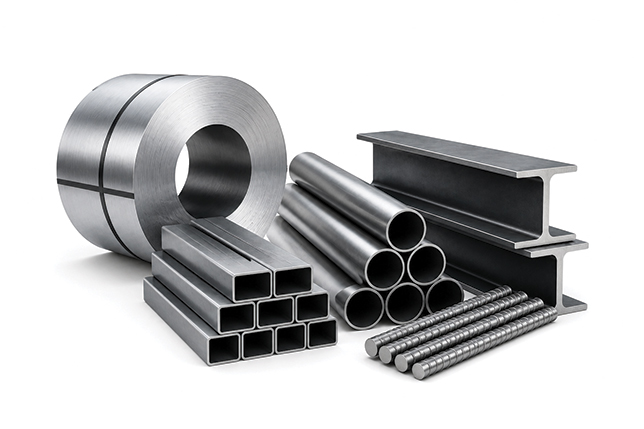
Steel industry is cyclical in nature
Impact
The steel industry, like most capitalintensive sectors, is inherently cyclical, which can impact margin stability and the availability of cash flows required to fund growth without placing undue pressure on the balance sheet.
- The steel industry is inherently subject to fluctuations, making margins and cash flows susceptible to variability across economic cycles.
- Steel prices have shown significant volatility in recent years, driven by changes in raw material availability and costs, shifts in global and domestic demand, capacity additions, and trade flows.
- Pricing is also influenced by broader economic factors, including transportation costs, trade policies, and geopolitical developments.
- Demand from key consuming sectors such as automotive, construction, infrastructure, appliances, and capital goods remains cyclical, further amplifying volatility in steel realisations and profitability.
Mitigation measures
- Scale advantage, with a large capacity base of 34.4 MTPA, supporting stronger cash generation through cycles.
- Improved margin profile driven by best-in-class conversion costs, enhanced product mix, and diversified market access.
- Continued focus on Value-Added and Special Products to reduce exposure to commodity price volatility.
- Enhanced raw material security, with a strategic roadmap to increase selfsufficiency levels in the coming years.
- Sustained cost optimisation through initiatives such as increased renewable energy usage, fuel efficiency measures, and logistics optimisation, including slurry pipeline infrastructure.
Raw material availability and cost of iron ore and coking coal
Impact
Our primary raw materials—iron ore and coking coal—along with other energy inputs such as thermal coal and natural gas, constitute a significant portion of our operating costs. The prices and availability of these inputs are influenced by multiple external factors, including:
- Global commodity price movements and currency fluctuations, impacting the landed cost after considering freight, tariffs, and exchange rates
- Government policies on mining, allocation, and import/export regulations.
- Weather-related disruptions, which may affect mining operations and supply chains.
- Geographic concentration of certain raw materials, leading to supply dependencies on specific regions.
Mitigation measures
Iron ore
- Iron ore requirements are met through an optimal mix of captive mines and external sourcing from key states including Odisha, Karnataka, Chhattisgarh, Maharashtra, and Goa, with captive sourcing contributing ~33% of total requirements in FY 2025–26.
- Regional sourcing strategy to optimise logistics costs and improve supply efficiency.
- Continued efforts to enhance captive resource security through participation in government-led mine auctions with a targeted increase in captive sourcing to ~50%.
- Use of hedging mechanisms to mitigate price volatility risks
- Procurement strategies linked to benchmark indices, with negotiated discounts where feasible, to manage input cost variability.
Coking coal
- Diversified sourcing strategy across multiple geographies, including Australia, USA, Indonesia, Mozambique, and Canada, to ensure supply security and reduce dependency on any single region.
- Optimised blending of different coal grades to manage input costs and mitigate the impact of price volatility.
- Increased stake in the Illawarra coking coal asset in Australia to 30%, ensuring longterm access to ~1.9 MTPA of premium low-volatile (PLV) coking coal.
- Advancing Mozambique coking coal assets development and evaluating strategic investments, partnerships, and acquisitions to strengthen long-term resource security, with a targeted increase in captive sourcing to ~50%.
- Progressive operationalisation of captive domestic coking coal blocks secured through recent government auctions.
- Procurement strategies linked to benchmark indices, with negotiated discounts where feasible, to manage price risk. Operationalising captive domestic mines won in recent auctions.
- Procurement of raw materials linked to benchmarked indices and discount to benchmark.
Infrastructure and logistics supply chain risk
Impact
A tonne of steel production requires 4X mass movement. Increasing production capacity will mean logistics risks such as:
- Infrastructure constraints for rail receipts / unloading as well as storage of raw material at plant locations.
- Limited availability of railway rakes impacting finished goods evacuation from plant locations.
- Road capacity bottlenecks, traffic restrictions, and rising road freight costs affecting first and last-mile connectivity.
- Slower development and utilisation of alternate modes (coastal shipping, inland waterways), limiting diversification of mode of logistics.
Mitigation measures
- Enhancement of pipe conveyor capacity to ~20 MTPA, reducing dependency on road and rail for iron ore movement from select mines to Vijayanagar Works.
- Implementation of a 30 MTPA slurry pipeline project to enable efficient transportation of iron ore from mines to ports for onward movement to plant locations.
- Increase in rail share through deployment of JSW-owned side discharge rakes (BOBSN).
- Development of additional rail and road entry/exit points to support higher throughput volumes.
- Expansion of raw material storage infrastructure through additional yards to cater to future growth requirements.
- Procurement of customised rakes under railway schemes such as the General-Purpose Wagon Investment Scheme (GPWIS) and Liberalised Special Freight Train Operator (LSFTO).
- Establishment of dedicated rake maintenance facilities near plant locations to ensure higher availability and operational efficiency.
- Development of additional railway sidings, including wagon maintenance and rake holding lines, within plant premises.
- Deployment of digital logistics solutions to enhance visibility across bookings, tracking, and delivery cycles, improving turnaround time (TAT).
- Development of alternate steel handling sidings and Private Freight Terminals to strengthen evacuation efficiency.
Changes in regulations and protectionism affecting ability to export
Impact
Risk of exports to EU and other key export markets due to changes in regulation, protectionism and other restrictions.
- Excessive exports by Asian countries especially China, due to significant depletion of domestic demand.
- Thrust on localisation by major advanced economies to protect domestic demand for their domestic steel producers.
- EU Emission Trading System compliance and Fuel Maritime compliance leading to additional ocean freight cost.
- Protective measures taken by Europe, the USA and Mexico. Europe and UK accelerated commitment to Climate Norms.
- CBAM's definitive phase went live on 1 January 2026, now requiring importers into the EU to pay for the embedded carbon emissions in covered products, including steel. This has a direct cost implication for our Company's exports to Europe. The EU has also announced plans to expand CBAM to specific downstream steel products from January 2028, further widening its scope and financial exposure.
Mitigation measures
- Strong domestic demand outlook, with steel consumption expected to grow at ~7%, providing visibility to absorb incremental capacity over the medium term, supported by infrastructure and manufacturing expansion.
- Flexible product portfolio and capabilities, enabling the Company to capitalise on export opportunities during periods of domestic softness and optimise realisations.
- Established global presence, ensuring diversified market access and reduced reliance on any single geography.
- Evolving trade agreements, including India–EU and India–USA engagements, along with potential future bilateral arrangements, are expected to mitigate tariff risks and support downstream sectors, thereby indirectly strengthening steel demand.
- We have undertaken detailed plant-wise emissions accounting aligned with EU-prescribed methodologies. EU-ETS-accredited third-party verifiers have been engaged, and all transitional-phase CBAM reports were submitted successfully.
Foreign exchange fluctuations
Impact
The steep depreciation of the rupee is driven by persistent foreign fund outflows, elevated crude oil prices due to the war in West Asia, India's import dependence and a strengthening dollar globally. Foreign exchange fluctuations and commodity price fluctuations impact profitability.
Mitigation measures
- Domestic steel pricing remains largely aligned with import parity, with a lag effect; as market leaders, we continue to strengthen pricing frameworks and discipline.
- A robust hedging framework is in place to manage risks arising from currency and commodity price volatility and is regularly reviewed at the Board level.
- Our Company's hedging strategy employs a prudent mix of forward contracts and options to effectively manage exposure to market fluctuations.
- Focused measures are being undertaken to hedge long-term capital liabilities while progressively reducing foreign currency exposure to strengthen balance sheet resilience.
Utility – water and electricity
Impact
Risk of disruption in production due to:
- Non-availability of water.
- Inadequate power supply to support enhanced capacity.
Mitigation measures
Water
- Our Company is developing large-scale reservoirs to create additional water storage capacity near our facilities. The construction of these reservoirs, coupled with our water-efficiency initiatives and site-specific Zero Liquid Discharge (ZLD) programmes, strengthens water security by enhancing freshwater availability, increasing resilience to seasonal variability and water stress, reducing dependence on external water sources, and supporting the continuity of operations.
Electricity
- Power will be sourced from the captive power plant and through long-term power purchase agreements with JSW Energy Limited and its subsidiaries.
- Additional transmission lines are planned for Dolvi, BPSL and Raigarh.
- Waste heat and gases generated from the blast furnace and coke oven will be utilised for power generation and heating requirements, thereby reducing the dependence on external power sources.
Occupational health and safety
Impact
The steel sector is subject to extensive health and safety laws, regulations and standards. Any safety lapses would result in damage or destruction of property, assets and human capital.
Mitigation measures
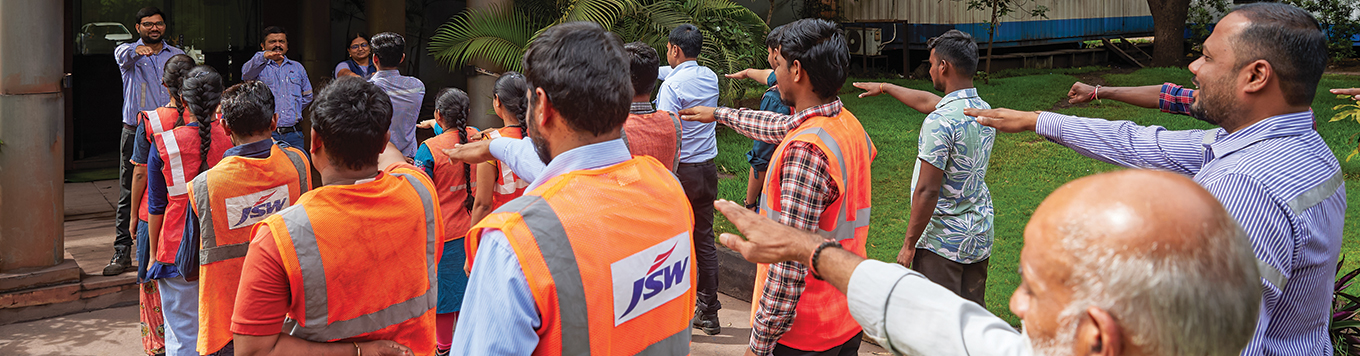
Ensuring compliance with local and international laws, regulations and standards with a primary focus on protecting employees and communities from harm and operations from business interruptions.
- Matured Safety Governance Structure is established including Group Safety Council, Group Level Sub Committee, Safety Steering Committee, Apex safety Committee and other sub committees for review of safety aspects, fatal accidents/near-miss accidents, if any.
- Periodic Safety Inspections, Internal and External Safety Audits ensure that our systems are properly implemented and compiled. Company-level JSAP (JSW's Safety Assurance) audits initiated using third party.
- Regular safety trainings are conducted based on the training needs identified across different skill levels of both staff and workmen.
- Robust security arrangements like security check posts, entry pass/identity cards, access control systems, CCTVs at critical locations.
- Subject Matter Expert (SME) training has been launched, covering Group Safety Standards to enhance employee competence, with several participants already certified as SMEs.
- 15 Group-Level Safety Standards are being updated or newly developed to strengthen safety practices, alongside the creation of Visual Standard Guidance for key standards.
- Safety Reward and Recognition Guidelines have been introduced at the Group level.
- The 'Safety Chatbot' at JSW enables employees to access safety standards and guidance instantly via text or voice commands in multiple languages.
Compliance risk
Impact
- Evolving regulatory framework may have material impact on operations.
- Deviation in compliance and non-adherence may impact reputation.
Mitigation measures
- A robust Legal Compliance management system is in place which ensures awareness and compliance.
- We are using technology to track compliance, timelines with suitable escalations, action plans and reviews.
- Compliance is being reviewed by Senior Management and Board of Directors on quarterly basis and initiation of remedial action.
Cyber security
Impact
Cyber security risk could damage reputation and lead to financial loss. Such threats arise from:
- Theft or leakage of corporate and sensitive information.
- Financial frauds, including unauthorised transactions and data manipulation.
- Ransomware and cyber extortion incidents.
- Disruption to critical business operations and digital services.
- Loss of business opportunities, contracts, or stakeholder trust.
- Third-party and supply chain related cyber risks.
- Regulatory and compliance implications.
Mitigation measures
- Information Security Management System aligned with ISO 27001:2022.
- Strengthening cyber resilience through:
- Integrated approach to detect, respond, and recover from cyber incidents.
- Regular testing of incident response and recovery preparedness.
- Human risk management:
- Organisation-wide cybersecurity awareness and training programmes.
- Regular simulations and targeted interventions to strengthen user vigilance.
- Third-party risk management:
- Risk-based assessment and monitoring of critical vendors and partners.
- Strengthening of controls across the extended enterprise ecosystem.
- Financial risk protection:
- Cyber insurance coverage maintained to mitigate potential financial impact.
Environment protection and climate change
Impact
- Regulatory and compliance risk: Progressive tightening of environmental and climate regulations in India and internationally may increase compliance costs, lengthen approval timelines, and influence future capacity expansion decisions.
- Resource availability risk: Increasing water stress across several regions in India may lead to regulatory restrictions, higher input costs, or operational disruptions for water-intensive processes.
- Strategic and financial risk: The need to transition to lower-emission production pathways may require significant capital deployment and technology adoption, influencing long-term returns and asset competitiveness.
Mitigation measures
- Decarbonisation and energy transition: Deployment of Best Available Technologies, expansion of captive renewable energy capacity, and pilot implementation of carbon capture and storage technologies to support long-term emissions reduction.
- Regulatory preparedness and compliance: Strengthened internal systems for environmental and climate compliance, including digital compliance management tools, enterprise-wide sustainability data systems, and regular senior management and Board-level reviews.
- Water stewardship: Adoption of water-efficient technologies, implementation of Zero Liquid Discharge programmes, enhanced rainwater harvesting, and creation of on-site reservoirs to strengthen long-term water security in water-stressed locations.
- Circularity and biodiversity: Promotion of resource circularity through waste-to-value initiatives, inter-industrial by-product utilisation, biodiversity management plans, and rehabilitation of mined land in line with internationally recognised standards.
- Product and market innovation: Development of low-emission steel offerings (JSW GreenEdge) and transparent product disclosures, including environmental product declarations, to support customers' decarbonisation objectives and enhance resilience to evolving market expectations.